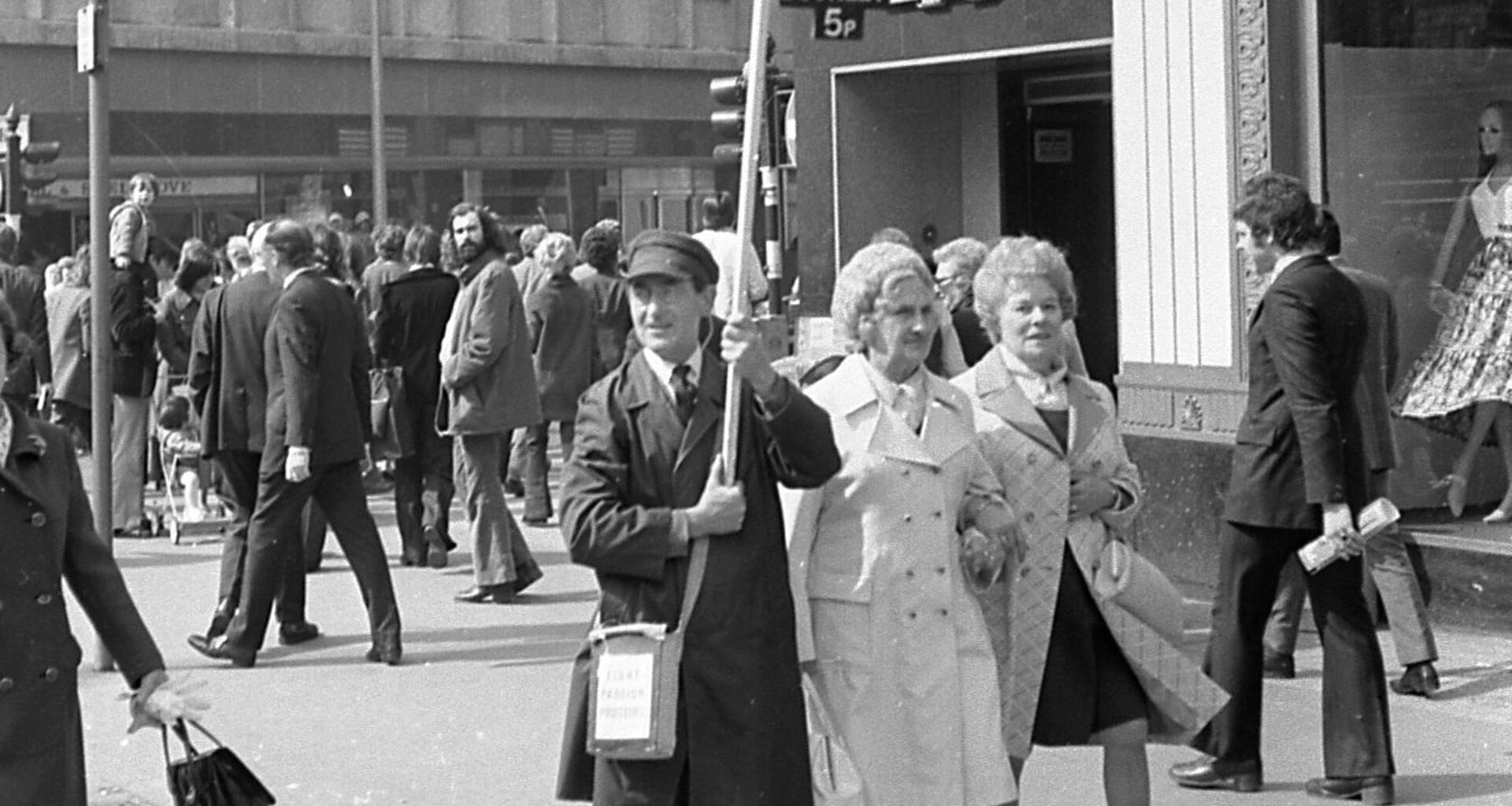
Stanley Green campaigned on a corner of Oxford Street in London for 25 years between 1968 and 1993. He and his homemade billboard and pamphlets, urging people to adopt a low-protein diet to dampen their passions, became part of the fabric of the city. A strange story of moral commitment, diet, and a crusade against lust, which may also be a lesson in resilience.
When I was a kid, my mum worked in an office just off Oxford Street in London. On the occasions that I got to go with her to her work, usually because of a dentist appointment or needing new shoes for school, we would get out of Oxford Circus tube station together, and there would be this guy standing on the pavement with a big hand-painted placard. It seemed to me that he was always there, no matter what day or time, no matter what season or weather. He was a constant, and his stoic commitment to his mission fascinated me.
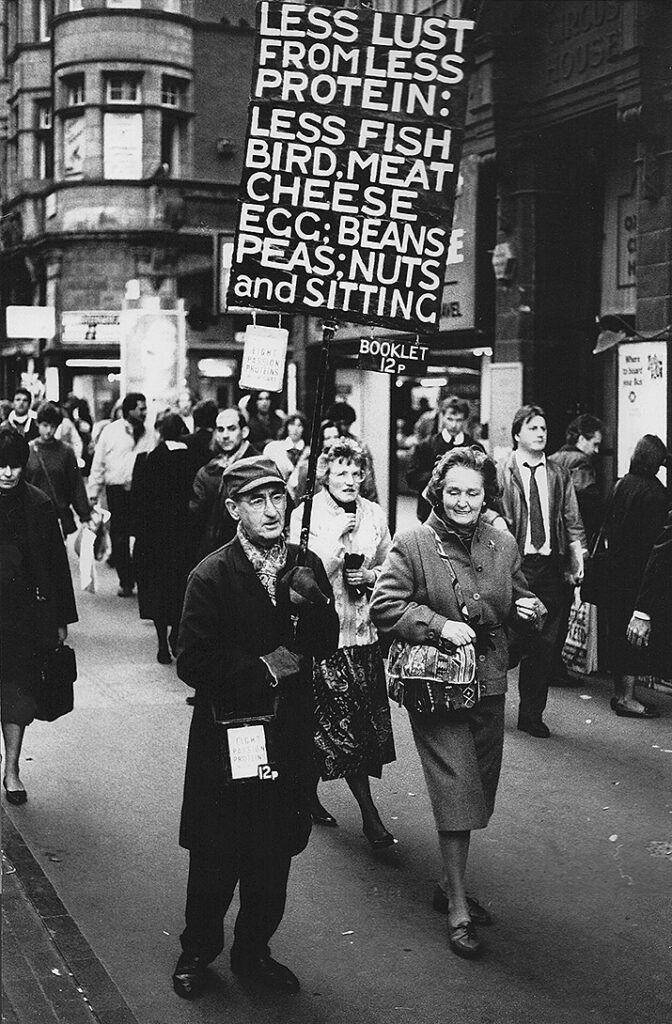
This human billboard remained at his daytime post throughout my teens. When I headed to town independently for early fashion forays with my friends, or for my brief summer holiday job at my mum’s office, there he was. He always seemed to be wearing the same outfit and carrying the same sign with the words: “LESS LUST, BY LESS PROTEIN: MEAT FISH BIRD: EGG CHEESE; PEAS BEANS NUTS. AND SITTING PROTEIN WISDOM” jammed across its surface.
He was always there, no matter what day or time, no matter what season or weather.
To young me, the man’s weirdly worded, weirdly punctuated, all-caps placard seemed to be a poem or code requiring analysis. I was pretty sure “lust” meant something to do with being greedy. As someone used to scarfing down a protein-rich cooked breakfast every morning, this message, which appeared to say my family’s eating habits were a “bad thing”, was disconcerting. It was the 1970s, pretty much everybody I knew consumed significant quantities of meat, animal fats and highly processed food three times a day, drank Ribena for “vitamins” and largely avoided vegetables. The sign’s inclusion of “sitting” was equally puzzling.
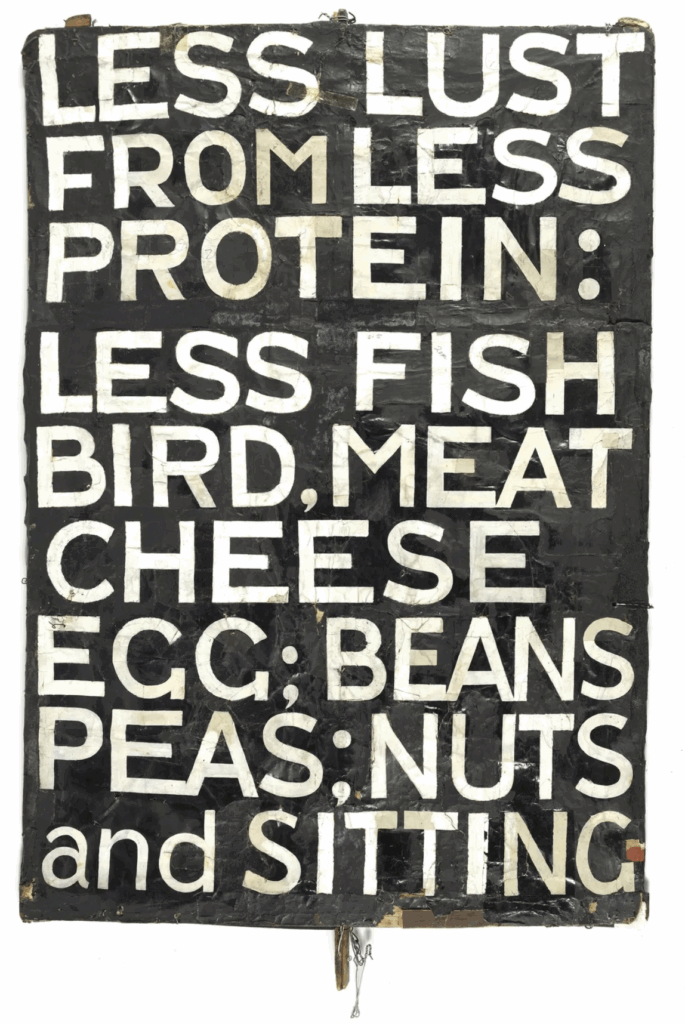
As I got older, learned about nutrition, dabbled in vegetarianism, and learned some of the broader implications of the word “lust”, I never once tried to buy one of the leaflets he was selling or ask him exactly why he was extolling the virtues of “PEAS BEANS NUTS. AND SITTING”. I think I didn’t want to know. Not because I was worried that I might feel morally compelled to give up eating bacon for breakfast (although that was a significant concern), but because I didn’t want to break the spell of his persistence, as immutable as any building on that busy city street. Over the years, I had become attached to the steadfastness of his crusade against the overconsumption of protein per se. I even agreed with him on that point. The potentially grubby and possibly weirdo elucidations concerning the evils of lust within his pamphlets, however, were not something I was keen on exploring in my teen years – probably much like certain aspects of adulthood.
Then I left home, my parents moved to the country, I went to college, and my visits to Oxford Circus became rare. Although on the odd occasion I happened to be in the West End during daylight hours, the man with the placard was still there too. Then, in the early 1990s, I moved to Berlin. I forgot all about Oxford Street’s human item of urban furniture until one afternoon in late January, when I was texting a friend in New York about a person dressed as a pink furry dildo wandering disconsolately down my icy street. I observed that they seemed to personify how everyone on the internet was feeling at the time – listless, lustless, lost and undone. And that to complete this picture of the absurdity of our times, the furry dildo person should really be carrying a sign proclaiming, “The End is Nigh”. Or at the very least, “Look Where Lust Got Us”.
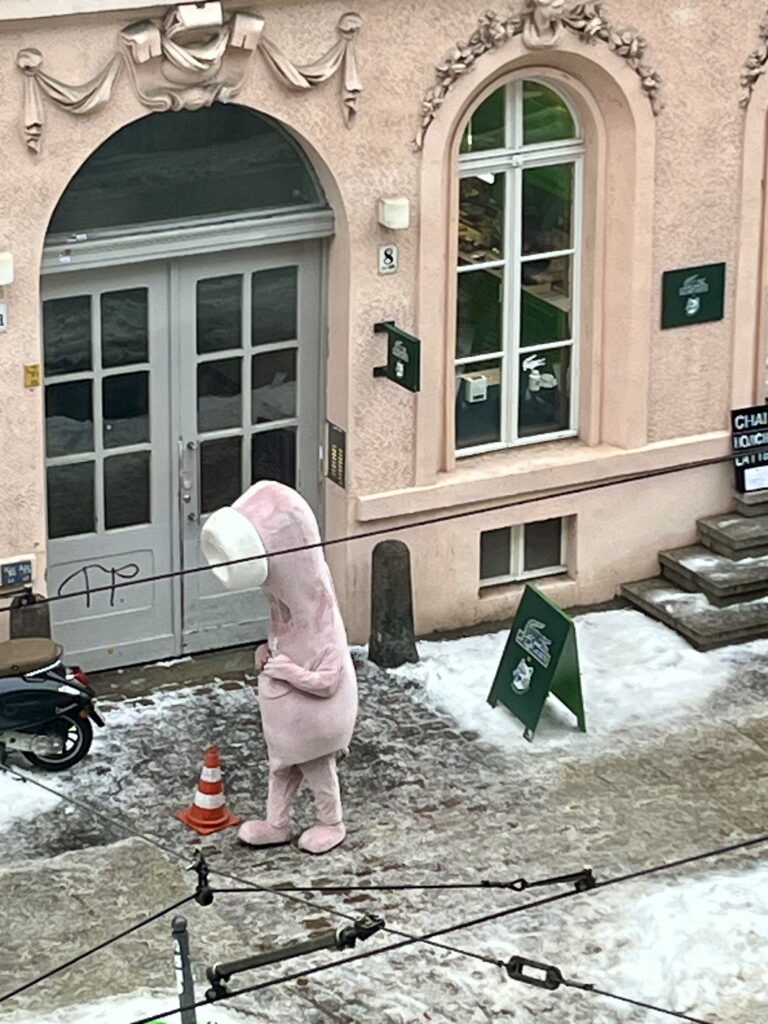
Bang. Suddenly, I remembered the PEAS BEANS NUTS guy.
So I googled him and (bless you, Wikipedia) all at once, the PEAS BEANS NUTS guy had a life and a name: Stanley Owen Green. He was born in North London on 22nd February 1915 and served in the Royal Navy right through WWII from 1938 to 1945. After the war, he had a couple of jobs but didn’t seem to keep any of them for long. He lived with his parents until they died in 1966 and then moved into his own council flat in West London. Then, at the age of 53, in 1968 (the year of Enoch Powell’s racist “Rivers of Blood” speech, the beginning of The Troubles in Ireland and growing Vietnam War protests) Stanley began a campaign of his own on the busiest shopping street in the country, if not Europe.
He was protesting through the time of the Cold War, the Afghan wars, Iran-Iraq, the Lebanon war, Watergate, and, closer to home, the Provisional IRA paramilitary campaign and the Winter of Discontent.
Context arrived with hindsight. I realised his protest lasted right the way through the time of the Cold War, the Afghan wars, Iran-Iraq, the Lebanon war, Watergate, and, closer to home, the Provisional IRA paramilitary campaign and the Winter of Discontent. The 1970s and ‘80s were violent and unstable times when the additional possibility of nuclear war felt like a constant and very real threat. But Stanley didn’t seem to be campaigning about any of that; he was just protesting about the relationship between a high-protein diet and lust, wasn’t he? And why was he so pro sitting when he clearly spent his days standing?
According to Wikipedia, every Monday to Saturday, for 25 years, Stanley cycled for over an hour from his home in Northolt to Oxford Circus, where he stood with his placard and sold leaflets until 6:30 pm, and then returned home.
“He rose early, and after porridge for breakfast, made bread that would rise while he was on patrol, ready for his evening meal. Otherwise, his diet consisted of steamed vegetables and pulses, and a pound of apples a day. Lunch was prepared on a Bunsen burner and eaten at 2:30 p.m. in a ‘warm and secret place’ near Oxford Street. The ‘warm and secret place’ was a bench at the far end of one of the platforms at Oxford Circus station, where he would sit after turning his placard upside down and facing the wall.”
“He rose early, and after porridge for breakfast, made bread that would rise while he was on patrol, ready for his evening meal.”
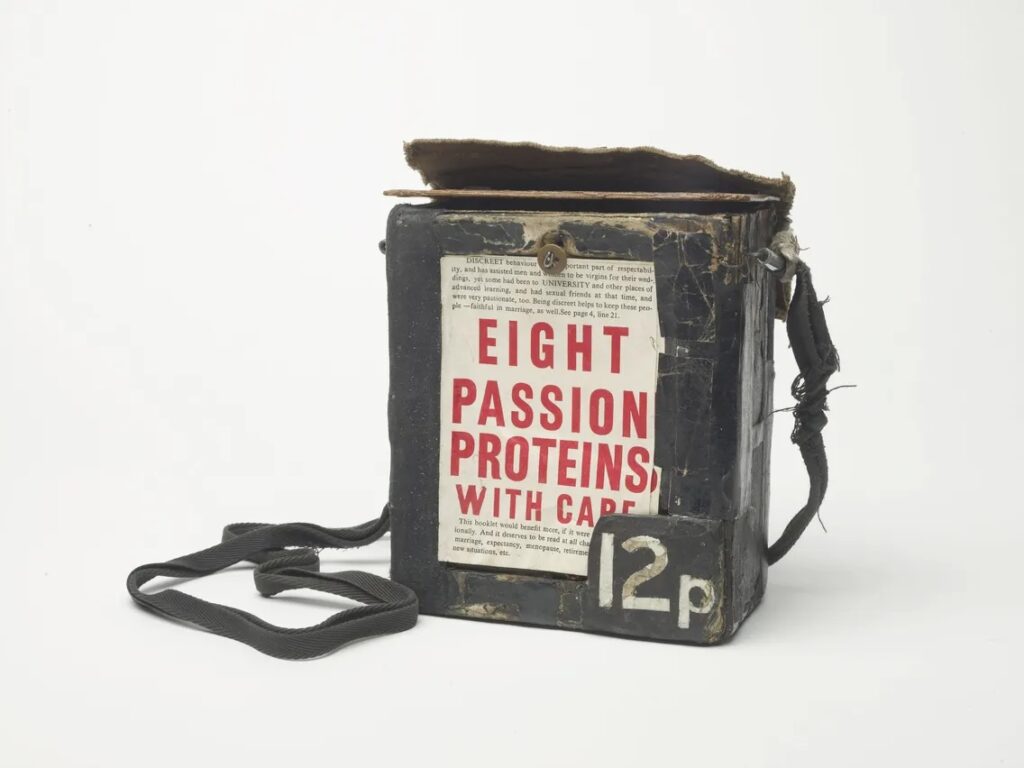
Stanley’s Sundays were spent writing his pamphlets titled Eight Passion Proteins and printing them on his own press. The subject matter was indeed about curbing the dangers of lust through diet and activity. He definitely didn’t eat bacon but did apparently indulge in the odd boiled egg, and (plot twist) he wasn’t pro sitting but against it:
“The pamphlets argued that ‘those who do not have to work hard with their limbs, and those who are inclined to sit about’ will ‘store up their protein for passion’, making retirement, for example, a period of increased passion and marital discord. They ended by warning: ‘Beware of the fun of indecent suggestions; of the amusement from the titillating scandal of private lives; of the diversion of the undress of low journalism etcetera. These things erode our morals and twist young minds.'”
Reading this, I began to get the impression that Stanley had had his fair share of trauma, and he dealt with it through his puritanical crusade. Perhaps he was hoping to save others from whatever had happened to him. Perhaps, having experienced so much war, he drew the conclusion that lust, or desire, was the root cause of aggression and therefore needed to be stopped. Or perhaps he was just lonely. Through proselytisation and advocating for wholesome exercise and a mostly vegan diet, when it was far from mainstream in the UK, Stanley sought to beat the devil on his own terms. Was he a proto-incel perhaps? If only he had used the force of his commitment to combat capitalism, power and toxic masculinity, I thought, instead of this side quest. Although if he had, you can guarantee he would not have been allowed to stand on that street corner with a shouty placard for 25 years. Perhaps he was just smart and protesting the real drivers of hostility in a way that wouldn’t get him arrested.
Perhaps he was just smart and protesting the real drivers of hostility in a way that wouldn’t get him arrested.
Whatever the underlying reasons for his epic campaign, it turns out I was not the only one who admired Stanley’s steadfastness. He was, I discovered, famous in London and beyond, albeit as a “lovable odd fellow” – the English love unthreatening lovable odd fellows. He was enough of a minor celebrity to be interviewed by the national newspapers, which called him the “Protein Man”, and featured him in numerous publications about the city. After his death, at the age of 78, in 1993, The Guardian, The Times and The Daily Telegraph all published obituaries. Stanley’s placards and pamphlets were later acquired by the Museum of London, and his printing press was exhibited at the Serpentine Gallery.
Although for most of his working life as a food campaigner of sorts, Stanley was largely perceived as an eccentric, yet harmless urban fixture by those who passed him every day, he still had an effect. Londoners saw him and remembered him. He stood up and stood fast for what he believed in for 25 years, mostly through indifference, but some hostility, from passers by, as well as two arrests for public obstruction. Now it’s 2026, and the West is in the throes of another era of violence and uncertainty. Perhaps there is something to learn from Stanley’s steadfast crusade about standing up, getting out on the street and protesting the people and structures that are the cause of our undoing.
Sophie Lovell is a writer and editor and the co-founder of studio_lovell and The Common Table. Born in London and based in Berlin, Sophie has been an editor at numerous publications in the fields of art, architecture and design, including uncube, form and Wallpaper* magazines. She has also written and edited many books on design and architecture, including David Thulstrup: A Sense of Place and Dieter Rams: As Little Design as Possible.
Title image: Stanley Green, Oxford Street 1974 © Sean Hickin