Michelin-starred chef Ivan Brehm worked at legendary fine dining establishments, including Per Se, Mugaritz, and The Fat Duck, before opening his own restaurant, Nouri, in Singapore in 2017. The Common Table speaks with this thoughtful culinary innovator about artifice, agency, and the unsustainable game fine dining has become.
Sophie Lovell: There has been a lot of reflection about practices in the fine dining industry lately. You have been working in that field for most of your life, so we are interested in hearing your take on it from both sides of the pass. Let’s start by asking: how do you feel the “spectacle of eating” in this context has changed in recent years?
Ivan Brehm: Dramatically. Food is, ironically, not the main consideration. A lot more focus is given to social capital, and meeting a certain aesthetic that gives the guest experience a degree of credibility. We’re in an interesting time as far as food’s concerned, because the arbiters of taste, who have created and improved standards in the fine dining community, have also pasteurised the experience. By that I mean, it’s easy to see the same dishes replicated time and time again, with the same aesthetics and the same ingredients.
Added to that is the fact that people often don’t trust their ability to understand what they like and what they don’t, which means they need more validation from media and guides like [The] Michelin [Guide] or [The World’s] 50 Best [Restaurants]. Michelin was born at a moment when a guest could trust their ability to like or dislike something, and that’s changing. Now, the guides and media in general are getting in the way of people’s direct experience of product; they are telling us what to expect, what to experience.
Now all you see is sameness and a focus that’s much more visual than it is gustatory.
Overall quality has improved dramatically, from the means of production to supply chain technology, but at the extremity where beauty and art are made, the same process has taken the edge off. Restaurants are safer than they’ve ever been. The boom of great exploration and genre-bending, of restaurants that were really trying to question what fine dining means, and whether food can be art, took place over a very concentrated amount of time. Now we’re on the other side of that curve, where all you see is sameness and a focus that’s much more visual than it is gustatory.

Orlando Lovell: So what does it mean to be a fine dining chef today? Are you an artist, a purveyor of pleasure, an entertainer, a business owner, an employer, or something else?
Ivan Brehm: It’s no longer enough just to have great service and cook exceptional food; people need to be entertained. Restaurants are a lot more preoccupied with making people forget life and be transported into an illusion. But in some ways, the greatest gift of food is the exact opposite. It’s about our ability to connect to each other, and to things that are real.
The job of a chef is to be a technological, artisanal producer of delicious things.
So, although the job of a chef has moved towards the job of an entertainer or media personality, it should actually be different. The job of a chef is to be a technological, artisanal producer of delicious things. Fine dining isn’t art; it’s artisanal. I think food can be art, but we’re missing the opportunities to explore that as much as we should. We’ve lost the ability to connect with and experience the product directly; everything is mediated by curation and narrative.
Orlando Lovell: In what context can food then still be art, if not in fine dining?
Ivan Brehm: People underestimate how related to class the concept of fine dining is. Although fine dining has become a realm where more and more people can feel “special”, money and class are still very much at its centre.
Also, most chefs have subscribed to the notion that their job is to do as little as possible to a product of extreme quality and value, which is fucking bullshit. That’s like being a glorified purveyor, playing middleman between a farmer and a guest. I think it was Pierre Gagnaire who used to say it’s very easy for a good chef to make a great dish with exceptional strawberries, but it takes a great chef to make a phenomenal dish with average strawberries.
But yes, food can be art. It can carry meaning. It can point to alternative ways of seeing the world, or help explain the world around us in a way that only art can.
Orlando Lovell: Let’s talk about the restaurant ranking organisations such as 50 Best and Michelin. Are there any benefits to these systems? Are they changing too?
Sophie Lovell: And why do we play the game?
Ivan Brehm: There are many answers to the question, Why do we play the game? The main one is because it’s a competitive industry that requires some level of safety and security. Restaurants are looking for safe bets and ways to sustain their business. Most chefs share, apart from a highly competitive streak, an attraction to the award system because of the potential benefit for business.
But the award system has now proliferated to an unprecedented level. Up until very recently, we had maybe three to four guides; now there are dozens, not to mention all the emerging regional guides. A positive aspect of this proliferation is that it has something to do with the decolonisation of taste and the arbiters of taste.
Up until very recently, we had maybe three to four guides, now there are dozens. A positive aspect of this proliferation is that it has something to do with the decolonisation of taste and the arbiters of taste.
The increasing number of guides has nothing to do with content and has everything to do with economic opportunity: business deals, partnerships, advertorial spaces, and so on. The relationship between the growth of the fine dining sector over the last 30 years and the burgeoning of the middle class, where extreme luxury became affordable luxury, mushroomed, and with it came an ecosystem that required support. Now that there are so many restaurants, how do we promote our product over somebody else’s, especially when customers have far less to spend?
Enter the PR and agency system. Now that we have a PR and agency system, how do we decide whether the product is good or worth spending money on? Enter the award system. And this circle jerk, pardon the expression, of restaurants that need promotion, promoters that need jobs, and media to validate it, becomes a closed loop. The system then becomes top-heavy, which, in turn, leads to an inversion of values: marketing, PR and media become more important than the producers and growers of food. So now we have an entire guide ecosystem engineered, not around restaurants or food, but around the reviewers who go to restaurants.
We have an entire guide ecosystem engineered, not around restaurants or food, but around the reviewers who go to restaurants.
These days, for a restaurant to be in the running for a potential spot in a guide like 50 Best, there is a calculation of roughly 100–200,000 US dollars of investment that has to be made to attract the right eyeballs who could then essentially promote your business within the 50 Best ecosystem by voting, article writing, and social media, etc. When the success of press trips became evident, more and more agencies started to offer this service, and again, competition at this level means that you now have to invest 200,000 instead of 100,000 to get visibility.
It escalated very quickly, and the 50 Best ecosystem, which used to reward restaurants that are smaller, potentially unknown, and offer incredible value or delicious, creative food, now rewards people who can afford the game. And who suffers there? The guest suffers from paying an inflated price because the promotional expenses need to be recouped. And the restaurant suffers because it cannot sustain itself while stuck in this vicious cycle. Michelin, to some degree, lives a little off to the side of that, but the rest of the guides don’t at all. They’re very much related to getting people to come to your place, and that costs money.
Sophie Lovell: How does the role of the influencer come into this equation?
Ivan Brehm: We don’t entertain them. Ten years ago, having the right person shoot a reel in your restaurant was instrumental to your success, but now, they’re a dime a dozen. It’s playing a game with a lot of hot air; the pyrotechnics are great, but what is it actually promoting? A product or an experience that is, for the most part, hollow.
The pyrotechnics are great, but what is it actually promoting? A product or an experience that is, for the most part, hollow.
Orlando Lovell: So many global systems appear to be dysfunctional, not least the food system. I’m wondering whether we will all continue to just watch them crumble, whether there will be a break, or whether the systems will be smart enough to adapt and fix it from the inside to bring about change.
Ivan Brehm: I think the system will do its best to regulate things without instrumental change. What I am noticing is that people who have opted out are still finding space for themselves, and that it is possible for sustainable businesses to exist inside and outside the fine dining sector that don’t subscribe to this pantomime. It might not expose a restaurant enough, but it sure as shit feels more equitable, and closer to the perfect circle that a restaurant used to be predicated under, producer/chef/hospitality/guest.
We’re noticing that it is possible, but technology makes it harder for us to see it as a possibility. We’re consistently bombarded with an onslaught of information and imagery that tells us we need to behave in a specific manner and participate in a specific way. But people are starting to realise the emptiness of it all, and that there might be other ways of doing things. Will it be enough to tilt the scales? I’m not sure.
Sophie Lovell: In evolutionary biology, there is this concept of adaptive mutagenesis, which is basically bet-hedging: in a time of crisis, species will chuck out as many variations as possible in the hope that some of them will survive. I feel a bit like the industry is doing that at the moment because everyone’s looking for what’s going to be sustainable, in the broadest sense of the term, in the long run.
Ivan Brehm: The industry has always been competitive. Since I’ve been a chef, even as a student, we were told that for every two restaurants that open, one closes. If we were having a conversation about concept development, artistry, or the direct involvement that a guest has with what they’re eating, I would say we are yet to rediscover our own ways of becoming creative and incorporating technology, technique, thought and beauty into a new way of looking at things. Similar to what happened with Heston [Blumenthal] and Ferran [Adria] 20 years ago, or with nouvelle cuisine. We’re still waiting to see what the next movement is going to be.
Humans have lost agency; we have outsourced it to guides, technology, and media. We’ve forgotten that we dictate where the market goes.
But if we used your metaphor in the context of the socioeconomics of restaurants, I agree that we are at a moment where things are just starting to fizz. Here’s what I think all of this is about: humans have lost agency; we have outsourced it to guides, technology, and media. We’ve forgotten that we are the ones who dictate where the market goes.
So if we ask, Where is the restaurant industry going to be in 10 years? We can try to predict it, but we can also say, “I don’t know. Where do you want it to go?” We’re at a moment where we are rediscovering, after maybe 15 years of being passive spectators in this manipulative spectacle of money, the fact that our decisions matter; that our voice matters. I know for a fact, talking about chefs and people within these ecosystems who play the game, that nobody who participates is satisfied with it.

Orlando Lovell: If nobody’s happy, what keeps you going?
Sophie Lovell: Or, in sustainability terms, how do you sustain good practice, reduce stress for yourself and your staff and help your own restaurants endure?
Ivan Brehm: I had to make a decision that wasn’t an easy one, and it was as much a business decision as it was a mental health decision: to stop caring about the goals and rewards of the game entirely. That helped; it created an easier environment for me, where I was only preoccupied with the task at hand. The place that I derive energy from, the thing that keeps me motivated, is the actual job. I see this as a practice, not as a business, and that’s the only way that I find solace and sustainability.
I had to make a decision that wasn’t an easy one, it was as much a business decision as it was a mental health decision: to stop caring about the goals and rewards of the game entirely.
If you ask me what my goals are for the future, I’ll tell you dinner service tonight is my goal, and then service tomorrow. I just keep the perspectives close, and I try to remind myself what got me excited about being a chef in the first place. The two things that got me into this job were the potential for creative expression and the human-to-human service and interaction. What made me hate my job was playing the game, feeling like I wasn’t enough and feeling that I could do more, that I could be better. So now I just focus on what I love, and that helps.
If you ask me what my goals are for the future, I’ll tell you dinner service tonight is my goal, and then service tomorrow.
Sophie Lovell: Going back to what you said earlier about decolonising the arbiters of taste, do you think opting out of the brigade system in the kitchen could improve well-being as well?
Ivan Brehm: Again, we’ve barely scratched the surface of what’s possible, because we accept the version that’s fed to us of how a restaurant should behave and perform. If you just see the restaurant industry as a fancy exercise in marketing, moving product from farms to guests, then all of these systems make complete sense because they facilitate and contribute to it. Is fine dining more than this? I believe we can be, and I’d like to work on that side of things because those systems don’t necessarily work for me.
As to who the arbiters of taste are, the biggest problem at the moment is that the guides are no longer equipped with a coherent voice that applies discernment across the board. A three-Michelin-star restaurant in the United States and a three-Michelin-star restaurant in Japan are vastly different as far as quality output is concerned. The way the industry has found to balance those contradictions is to say that food is subjective and everybody has different tastes. But an overcooked steak is an overcooked steak, right? Pairings that make sense are pairings that make sense. I welcome these questionings, because I don’t necessarily think the Michelin is the be-all and end-all arbiter of what a meal worthy of your time should be. We should spend more time empowering people to determine what that is for themselves. My biggest frustration is that it really isn’t about the product or output; it’s all become about perceived value – of an ingredient, a wine, or an experience.
Sophie Lovell: The universal monetisation of everything.
Ivan Brehm: Yeah, and that movement is not exclusive to dining. The fact is, the economic system supporting all of this is crushing; it isn’t life-affirming, it is exploitative and divisive. If we want to improve restaurants, we can only do that to the degree that we also improve the system. So these conversations should be had together.
The fact is, the economic system supporting all of this is crushing; it isn’t life-affirming, it is exploitative and divisive. If we want to improve restaurants, we can only do that to the degree that we also improve the system.
At Nouri, we operate lateral hierarchical systems that become vertical only in times of extreme stress. We have a restaurant that is extremely gender balanced, with a tilt towards more women than men, which is engineered and baked into the system. We like working with organic farmers and producers, but we’re not a restaurant that’s focused on ecological sustainability. We just try to do our best in that direction. All of these conversations are more related to our commitments to doing good than to us picking a sound bite and driving that as our unique identifier, our selling point.
Orlando Lovell: It is really hard, though, to change the system of a restaurant that is running to capacity in a tough economic climate.
Ivan Brehm: There’s a way for the system to correct itself, but it only takes place when we put ourselves at the centre instead of being passive observers. We are, in fact, agents. When we rediscover the human courage to do something because it feels right to us, and not because we’re trying to exploit or win, then things might change.
When we rediscover the human courage to do something because it feels right to us, and not because we’re trying to exploit or win, then things might change.
The bigger problem is that our relationship with everything in life right now has been about the exploitation of systems. The systems are breaking down throughout because things stopped having value in and of themselves. A diner’s dinner isn’t enough; it has to do more than a dinner is supposed to do; remove the diner from their reality and give them something different, because the one they live in isn’t good enough. If we stop going in that direction and do things because of the inherent benefits they give us immediately, the whole thing falls back into place. To go organic just because it’s better in and of itself should be enough; to run an equitable kitchen should be enough; to cook for people to eat should be enough.
To go organic just because it’s better in and of itself should be enough; to run an equitable kitchen should be enough; to cook for people to eat should be enough.
When you do away with all the inflated hot air of speculative interest, and you bring things closer to yourself on a day-to-day level – your interaction with your team, with the guests, with the creative impulse and the dish – when you start to reduce your life to these real things, you run a different risk of actuallybecoming financially sustainable and doing all right without having to play an artificial game.
Orlando Lovell: Would that be your answer to our next question, What makes a restaurant special or even great?
Ivan Brehm: Great restaurants are places of presence, meaning, mindful engagement and relationships. The biggest lie is that a restaurant is about food. It’s ridiculous. A restaurant is about people; it’s a people-to-people, dynamic place that is mediated by food. Restaurants that have managed this balance are places that last in people’s psyches forever.
The biggest lie is that a restaurant is about food. It’s ridiculous. A restaurant is about people; it’s a people-to-people, dynamic place that is mediated by food.
Sophie Lovell: This interview has been such an interesting journey. I’m going to ask you to summarise it with one last question: If you could radically rework the fine dining system, what would you change in the context of what we’ve been talking about?
Ivan Brehm: I would remove the arbiter. I would take away the arbiter of taste, the leveller, the judge, the critic. I think we would lose a few things with it, but what we gain in return would be worth it.
Ivan Brehm is the chef-owner of the Michelin-starred restaurant Nouri in Singapore (est. 2017) and the creative interdisciplinary space Appetite (est. 2020). Following several years working in the kitchens of Per Se in New York, Hibiscus in London and Mugaritz in the Basque Country, Ivan joined Heston Blumenthal, where he was Development Chef at his Experimental Kitchen at The Fat Duck for 4 years. With a mixed heritage of Italian, German, Russian, Spanish, Lebanese, Syrian and Brazilian, Ivan has developed a cuisine as eclectic as his own lineage. His dishes at Nouri integrate influences from around the world to produce dishes that reflect what he calls “crossroads thinking”, “challenging conventional notions of identity and emphasising that no culinary tradition exists in isolation”.
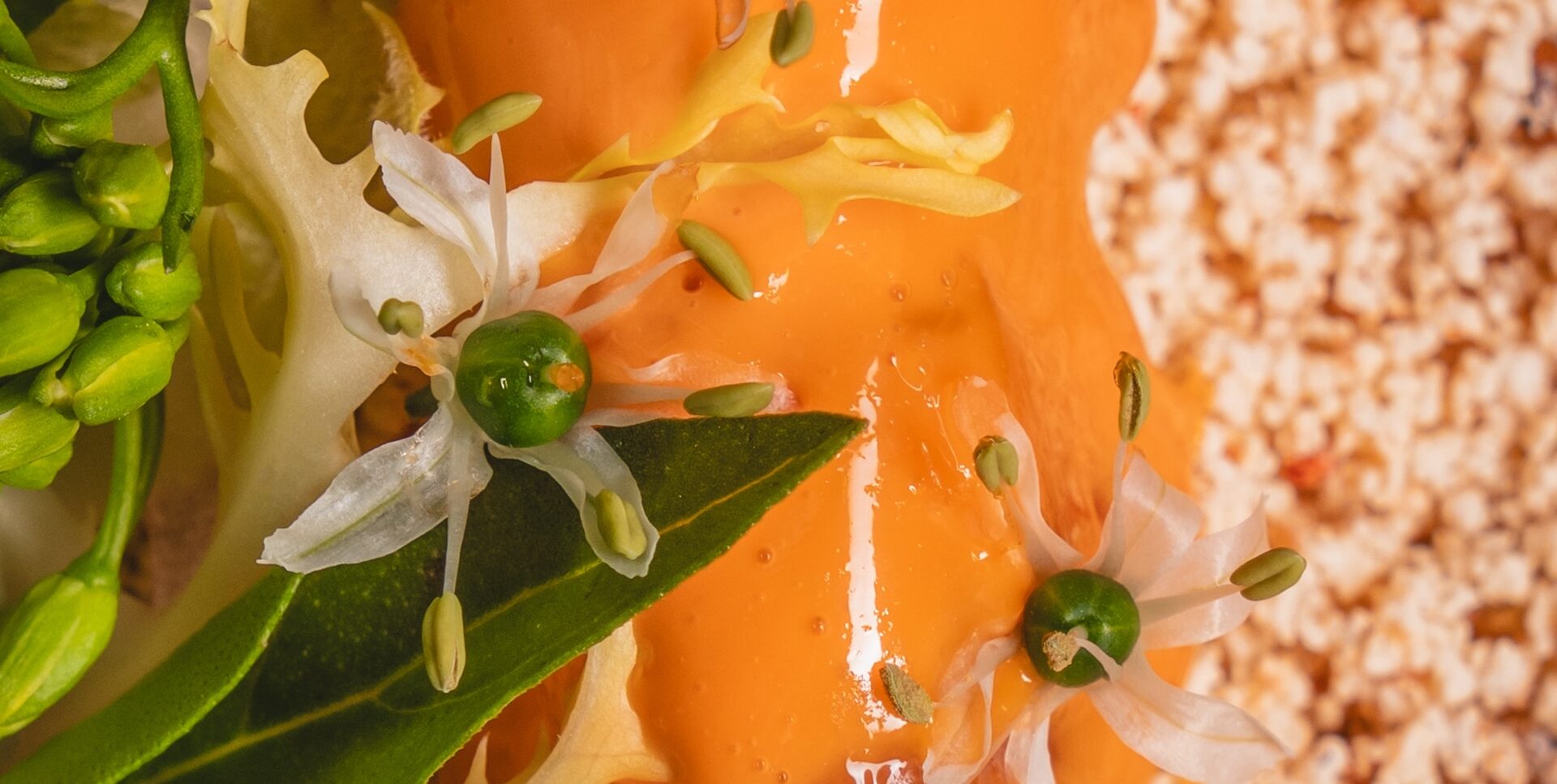
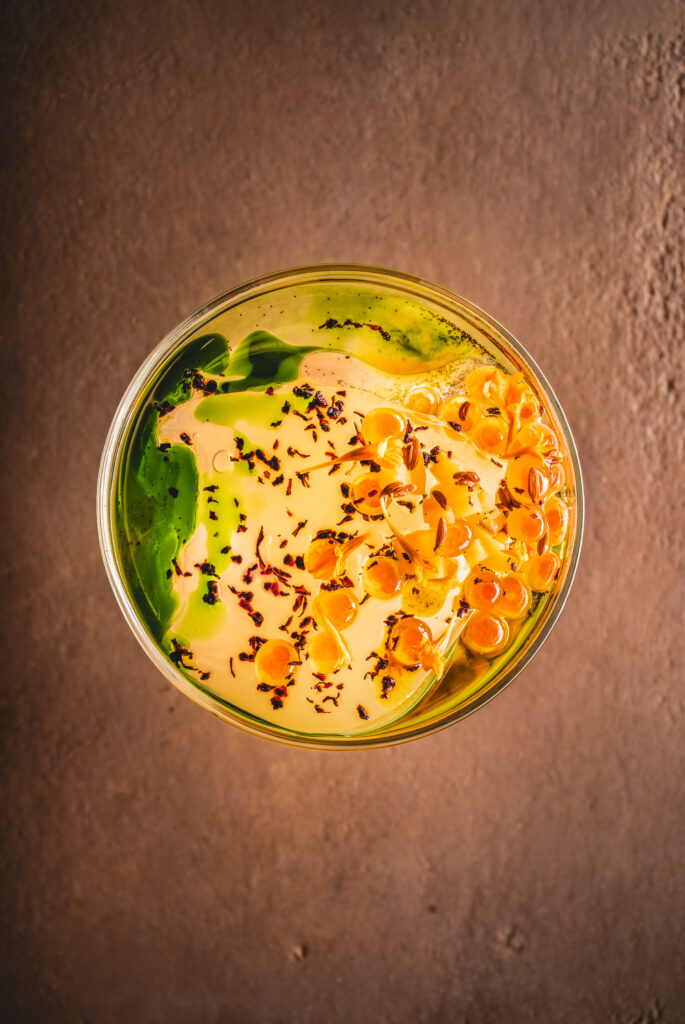
Title image: shirasu sambal, tapioca and coconut emulsion, mazara red prawn beiju, photo © Rachel Tan, courtesy Ivan Brehm & Nouri