A self-published handbook from a Notting Hill vegan restaurant might seem an unlikely vehicle for a radical food systems manifesto, but Farmacy’s Manifesto on the Future of Food makes a compelling, if imperfect, case for regenerative agriculture and the urgent need to rethink how “we” feed ourselves.
An upmarket vegan restaurant in Notting Hill with its own biodynamic farm in Kent is not normally the kind of commercial project you would expect a radical food manifesto from. But these are not normal times. Farmacy was founded in 2016 by Camilla Fayed after she discovered the health benefits of organic food. Her farm is based on the principles of Rudolf Steiner and his Biodynamic Demeter federation, and the restaurant serves wholesome meals from the farm’s produce. Since its foundation, Farmacy has expanded its mandate to advocate for the belief that chefs and restaurants of the future need to become ambassadors for regenerative food systems and effectively reflect their local landscapes and has begun collaborating internationally.
To spread the essential message of supporting food system transformation for the sake of human, soil and planetary health, Farmacy have enlisted writer and filmmaker Aurora Solá, art directors Carol Montpart Studio and illustrator Batia Suter to create a handbook and short film, both titled: Farmacy: Manifesto on the Future of Food endorsed on the inside cover by Woody Harrelson (actor and narrator of the Netflix documentary Kiss the Ground) and food sovereignty advocate Vandana Shiva.
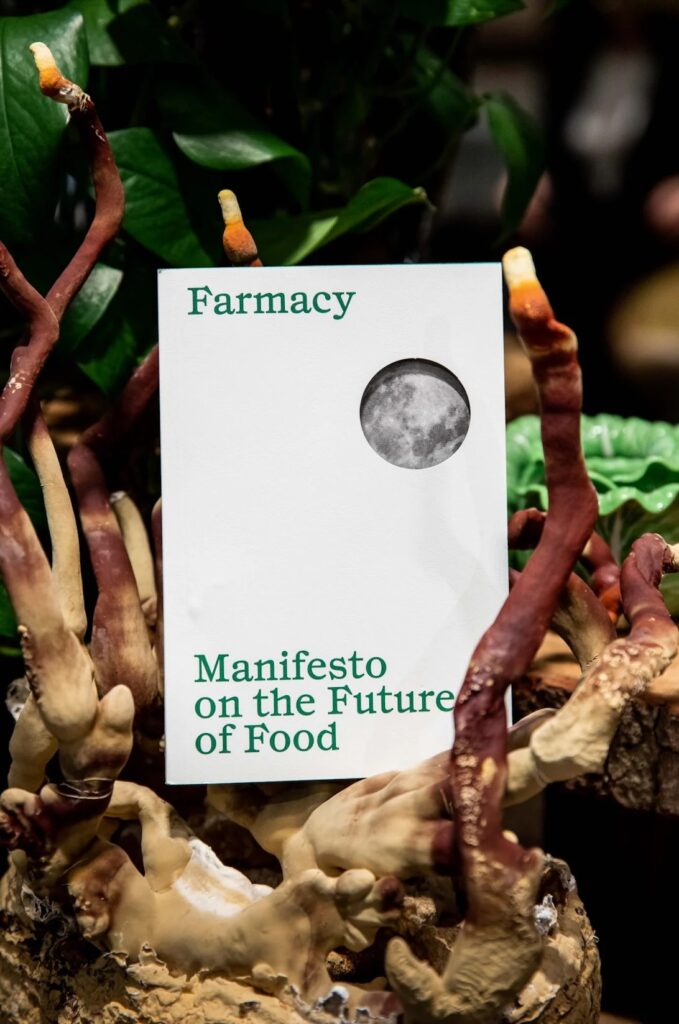
Altogether, the book delivers a digest of the food-system-change message in strong and convincing tones. There is a concise summary of the horrors wrought by industrial agriculture on both human and soil health, as well as a justified attack on the status quo of the industrial food industry, plus an argument for the benefits of regenerative agriculture for the human body and civilisation as a whole (“food is the medicine for healing humanity”). It sings the praises of “real food” and ferments. It also criticises GMO seeds, fertilisers and some sweeping statements about mass consumption food products: “Most of what is sold as food in supermarkets is not actually food but what some doctors now call ‘food-like products’”.
Putting together a vision for “reengineering the way we feed ourselves” is not only admirable but essential for surviving the coming years. However, there is a tension in the book’s implied audience that is never quite resolved. The classy production, the Notting Hill provenance, and the price of biodynamic produce are not neutral signals. The Farmacy Manifesto speaks in a universalist register (“our civilisation”, “humanity’s health”) while existing within an economic ecosystem accessible to relatively few. Nearly every paragraph contains the word “we”, for example: “Today, in our fast-forward and dulled state, we understand food as fuel and convenience…”. But each time, that tiny word “we” carries a question along with it that sits uncomfortably with the reader: Who is we?
Having said that, Farmacy’s manifesto still makes essential points clearly and effectively, provided it is consumed with an awareness of its Western-paradigm perspective – one that is only now coming around to understand what most farmers have known for millennia. For its core recognitions alone, such as the interconnected power of ecology, that human health is directly related to the food consumed, that soil is a powerful living entity, and that a regenerative agriculture which “recognises our embeddedness within the living ecologies of the planet” is the only way forward, this book is to be recommended. As a message to those who still consider “everything is connected” to be a radical statement, it is an excellent digest.
Farmacy: Manifesto on the Future of Food is available here.
Image and video © Farmacy