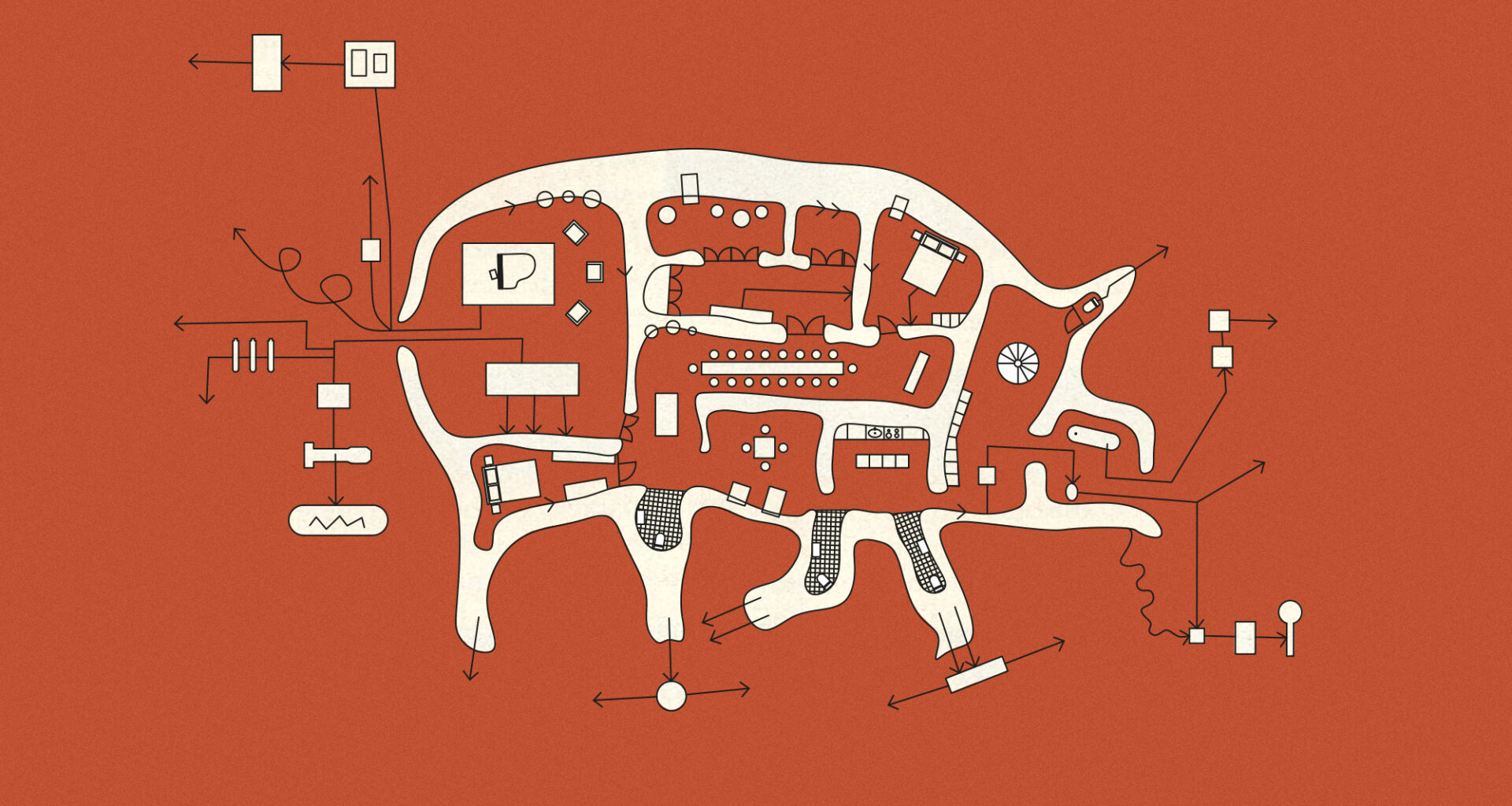
Twenty years after Christien Meindertsma mapped 185 products from a single Dutch pig, Cooking Sections are back in pig territory. But their new exhibition at Denmark’s MAPS Museum doesn’t just reveal what industrial farming does to a landscape and its people; it also invites them to fight back.
Daniel Fernández Pascual and Alon Schwabe, collectively known as Cooking Sections, are designers after The Common Table’s own heart. They investigate the systems shaping the world through the lens of food, working collectively and interdisciplinarily in long-term projects such as the self-initiated Climavore; exploring “how to eat as humans change climates and how to metabolise climate breakdown”.
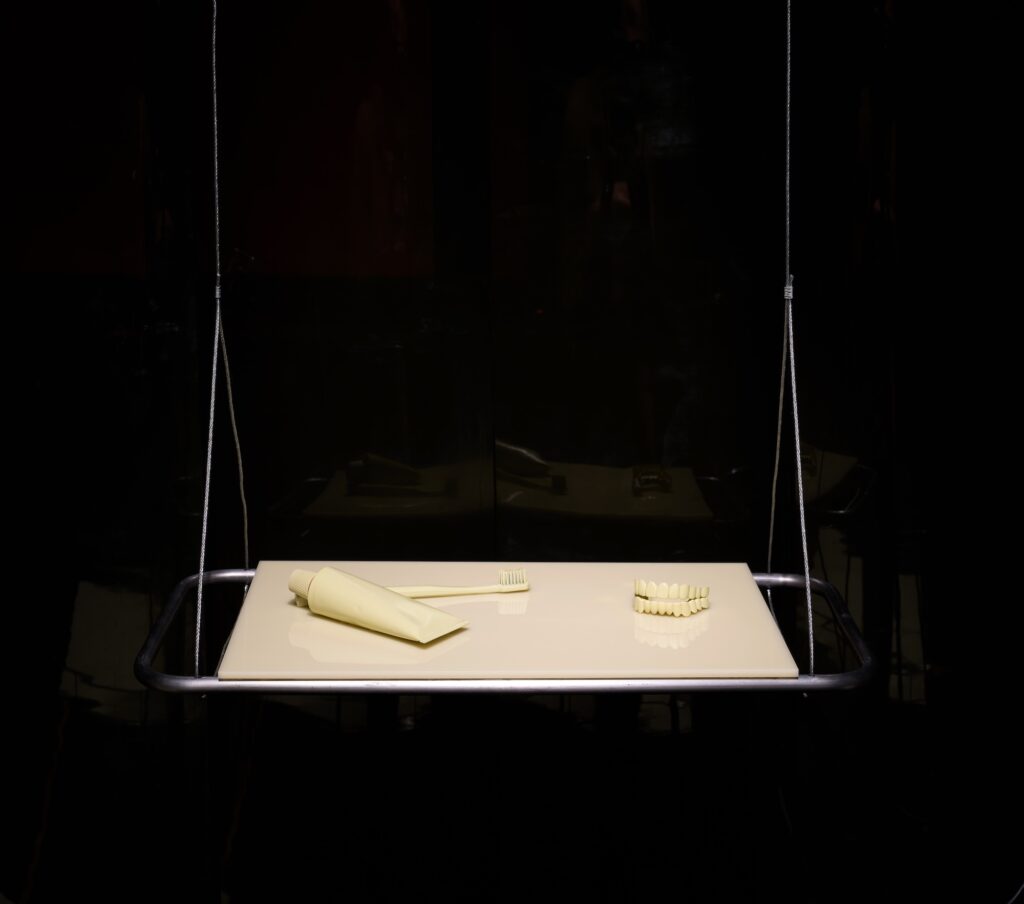
Cooking Sections’ newest exhibition is at the Danish Museum of Art in Public Spaces (MAPS). Called the House that Pigs built, the installation, curated by MAPS Senior Curator Irene Campolmi, is the result of over three years of close collaboration with the museum and aims to expand understanding of public space into the agricultural landscape through a systems-oriented investigation of Danish pig farming.
“The pig’s body becomes not only food but also medicine and building material – from hormone production to smooth surfaces and architectural finishes.”
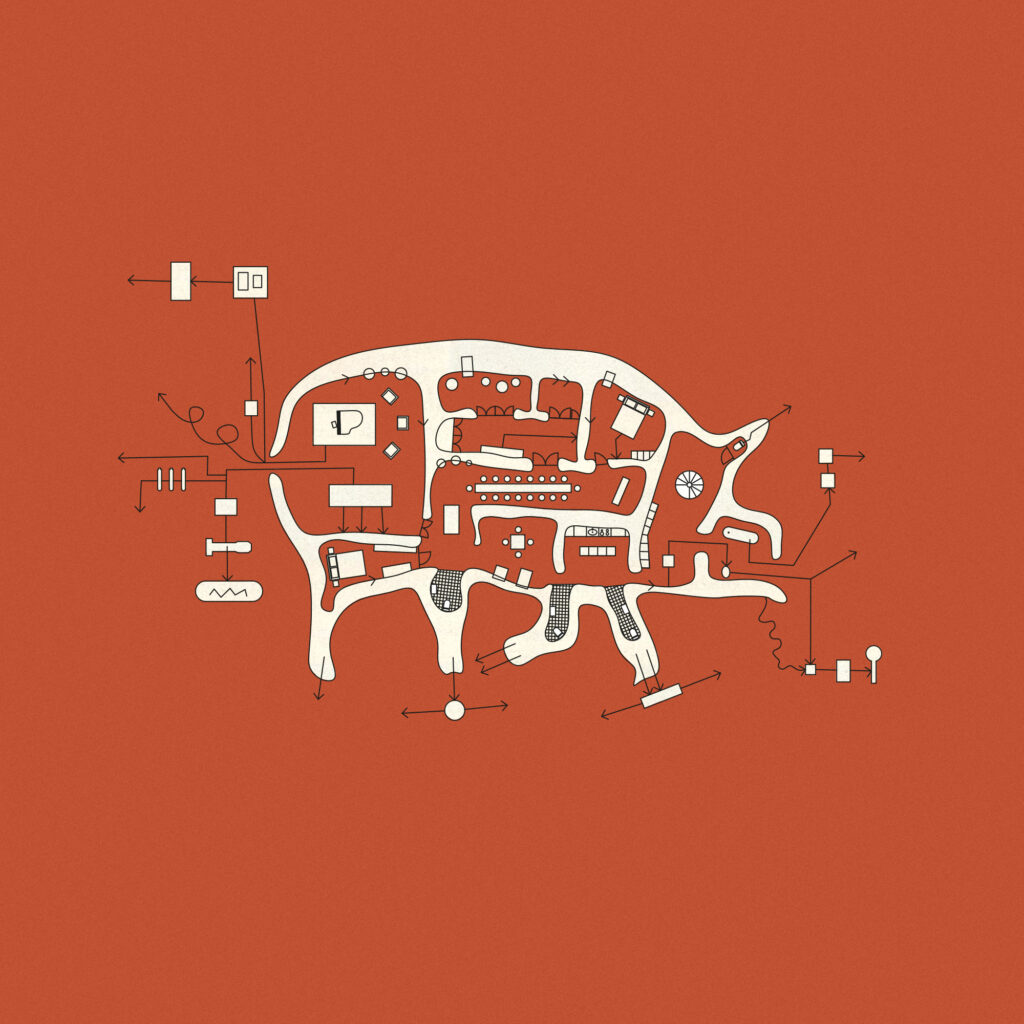
In Denmark, says the exhibition introduction, “pigs outnumber people by more than five to one. Industrial agriculture shapes the landscape and creates complex entanglements between food production, biotechnology, and architecture. The pig’s body becomes not only food but also medicine and building material – from hormone production to smooth surfaces and architectural finishes.”
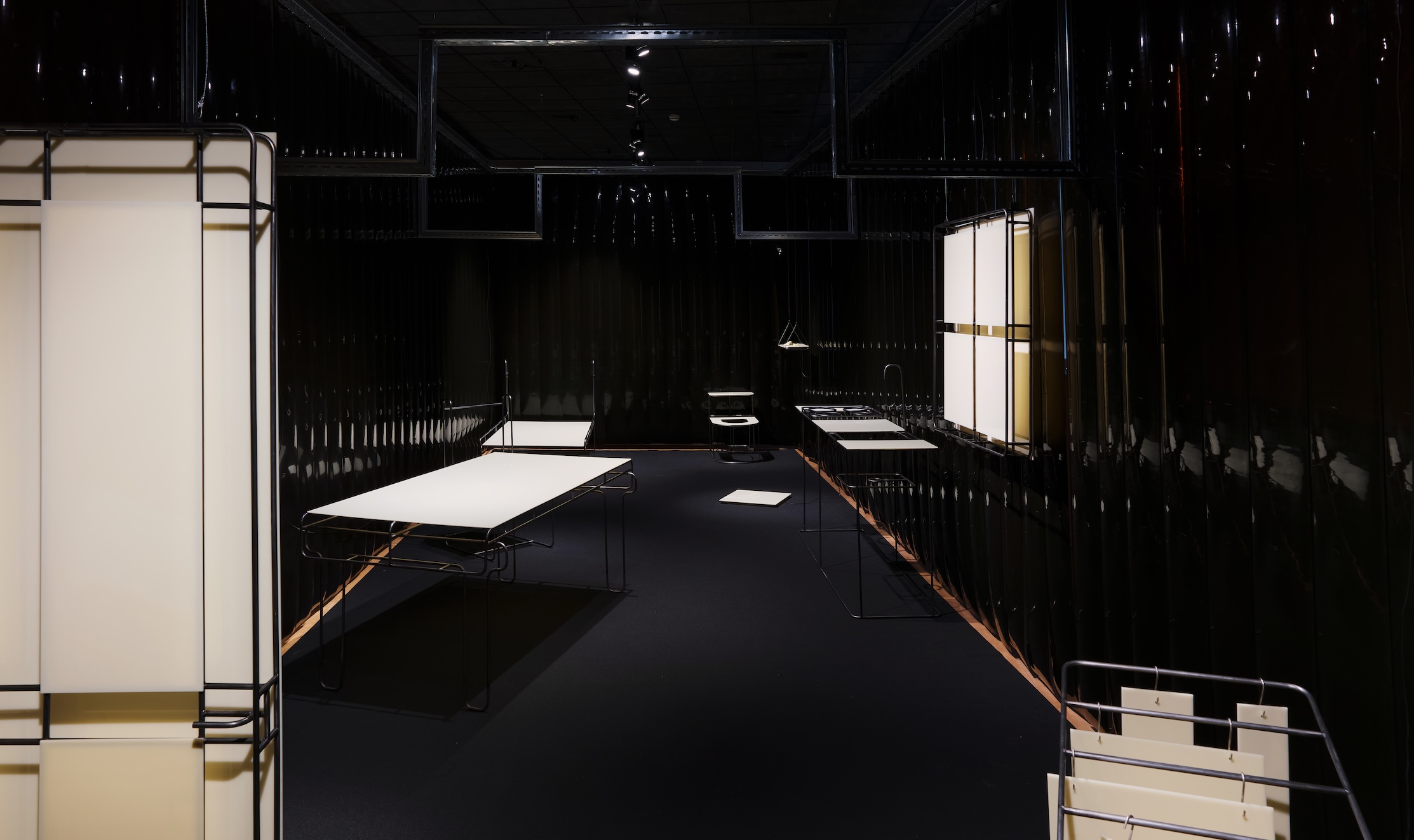
Developed in collaboration with historian Hannah Landecker, a specialist in the intersections of biology and technology, the designers make use of recordings to create an immersive soundscape in which voices explain the processes and “metabolic transformations that turn pig renderings into chemical agents and agencies shaping domestic environments.”
In 2007, the Dutch designer Christien Meindertsma famously tracked all 185 products from a single Dutch pig over three years, showing how “material of pig” is far more widely used than most people assume and has applications in an astounding variety of industries and products. She presented her research in a book called Pig 05049, which became a benchmark of research-led conceptual design. This kind of design practice – where the object or publication is the vehicle for broader critical inquiry and making information transparent for non-expert audiences – is very much the terrain that Cooking Sections’ work expands upon, taking it further in a way one might call enactive design.
This kind of design practice is very much the terrain that Cooking Sections’ work expands upon, taking it further in a way one might call enactive design.
Notably, the House that Pigs built takes up where the matter-of-fact Pig 05049 left off almost 20 years ago, by doing the complex research into what its authors call “metabolic transformations that turn pig renderings into chemical agents and agencies shaping domestic environments”. The exhibition shows how the bodies of pigs are reduced to a collection of properties that are opaquely embedded in the viewers’ own everyday lives. Outnumbered as they are 5 to 1 by the pig population, Danish citizens are therefore living in and surrounded by the lives and dead bodies of these creatures. But instead of just dumping that information on the audience, the exhibition initiates a collaborative and activist reaction. Here in Cooking Sections’ own words:
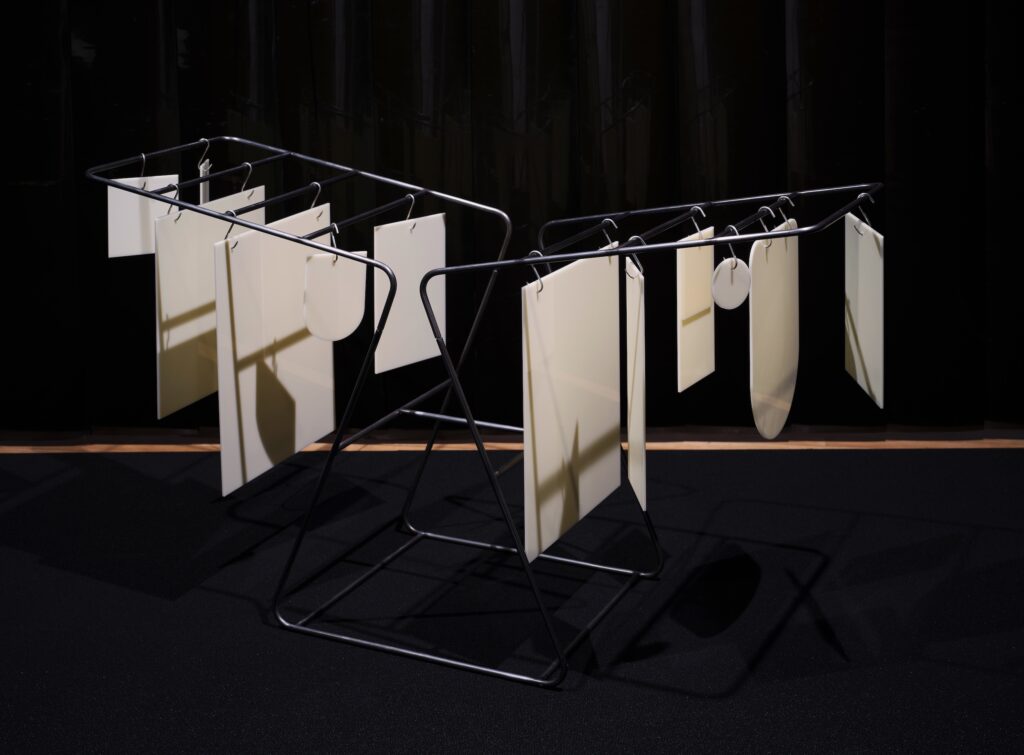
“The project focuses on Denmark, a context unparalleled in Europe, where pigs outnumber people almost five to one, and where pig bodies are rendered into properties of smoothness and hydrophobicity that seem to be everywhere and come from nowhere, yet people still live in the places in which these bodies grow and die. Here, the result of economies of domestic comfort is life lived with the residue of pig value right in front of the door.
“The installation, therefore, speaks alongside Svinealarm: a new civic empowerment tool that scans municipal websites across Denmark to identify and track applications for megafarm construction and expansion in real time. It issues public alerts, making civic participation in environmental decision-making more accessible for residents. Released ahead of the 30th anniversary of the Aarhus Convention, which guarantees public rights to environmental information and participation across Europe, the tool invites residents to reclaim public oversight that is technically possible but practically inaccessible, alongside their right to transparency in planning processes, and ultimately, to resist the expansion of megafarms near their homes. We invite visitors to engage with planning processes and express their objections to the expansion of ecological damage in the country.”
Just because a production chain is circular does not mean it is sustainable, more efficient, or indeed ethically acceptable.
By collaborating with residents and environmentalist groups who oppose mass pork farming developments, their project is, they say, proactively contributing to the revision of prevailing assumptions about what “circular economies” mean. Just because a production chain is circular does not mean it is sustainable, more efficient, or indeed ethically acceptable.
Cooking Sections’ goal is for this three-year project to continue beyond the exhibition space because they believe that revealing the relationships between public space and soil and land struggles is an essential way of shifting discourses on what public art can mean. In doing so, they are helping the public see how they, too, can contribute to the reimagination of their country’s relationship to its land and rural ecologies. This is not just research-oriented design practice; it is both enactive and activating. It opens participatory paths for the designer and visitor alike, away from the passive consumption of even more bad news about how terrible the house that humans built has become.
Cooking Sections are Daniel Fernández Pascual & Alon Schwabe. They are Readers in Architecture and Spatial Practice at the Royal College of Art, London, where they lead CLIMAVORE x Jameel at RCA. They are also Fellows at the Canadian Institute for Advanced Research. Cooking Sections was nominated for the Turner Prize in 2021, received the Special Prize at the 2019 Future Generation Art Prize and was nominated for the Visible Award for socially engaged practices. Daniel was also awarded the 2020 Harvard GSD Wheelwright Prize for Being Shellfish.
The House that Pigs built, was curated by MAPS Senior Curator Irene Campolmi. It is showing at MAPS, the Museum of Art in Public Spaces in Köge, Denmark, from March 19 to August 2, 2026. Title image © Cooking Sections, courtesy MAPS.