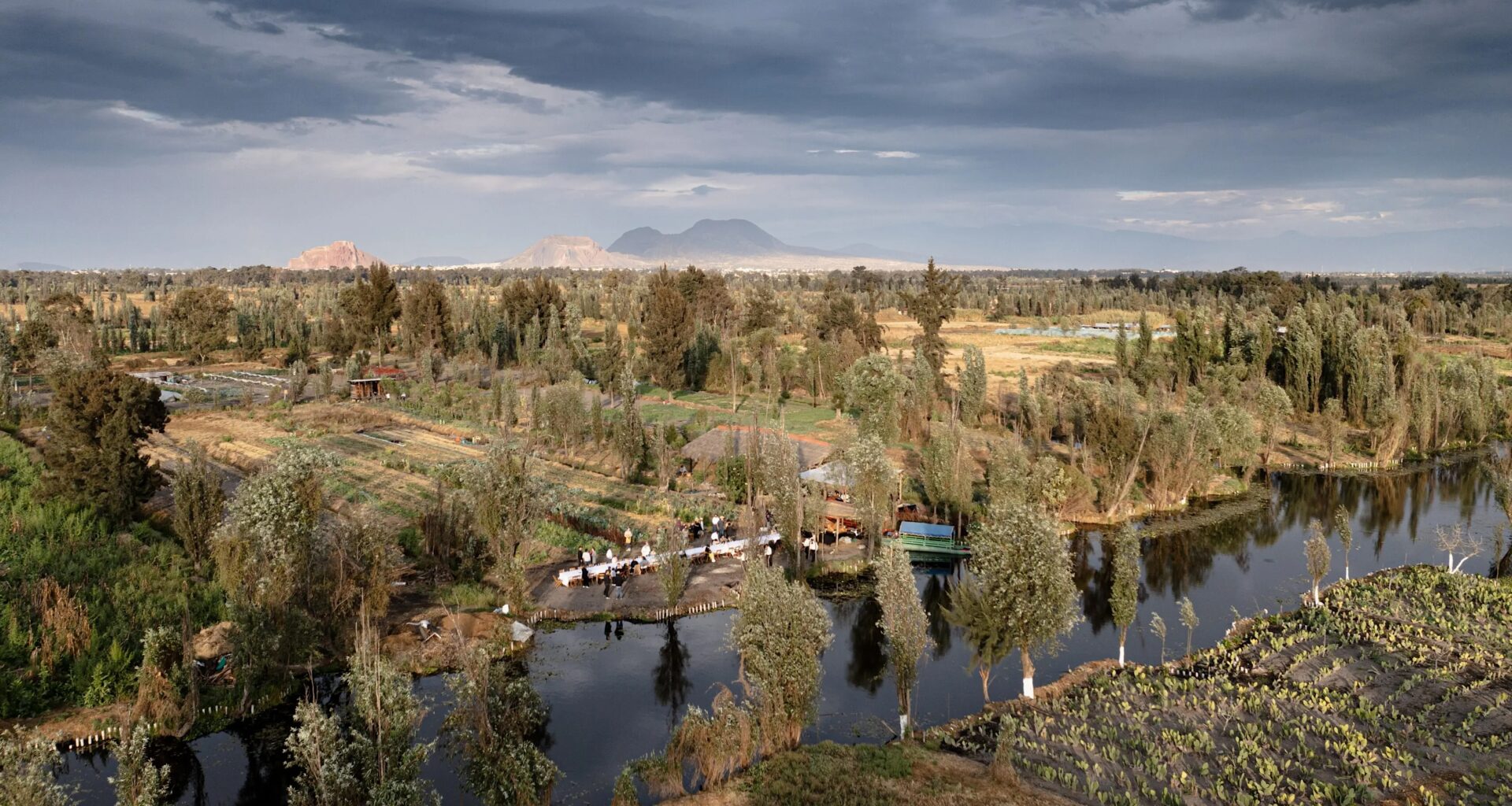
A collective called Arca Tierra is reviving the ancestral agriculture practices of a unique farming landscape outside Mexico City, called the Chinampas. They supply 50 of the city’s top restaurants, as well as local families, with ingredients. The Common Table spoke to the farm coordinator, Sebastián Herrera, about finding what was lost.
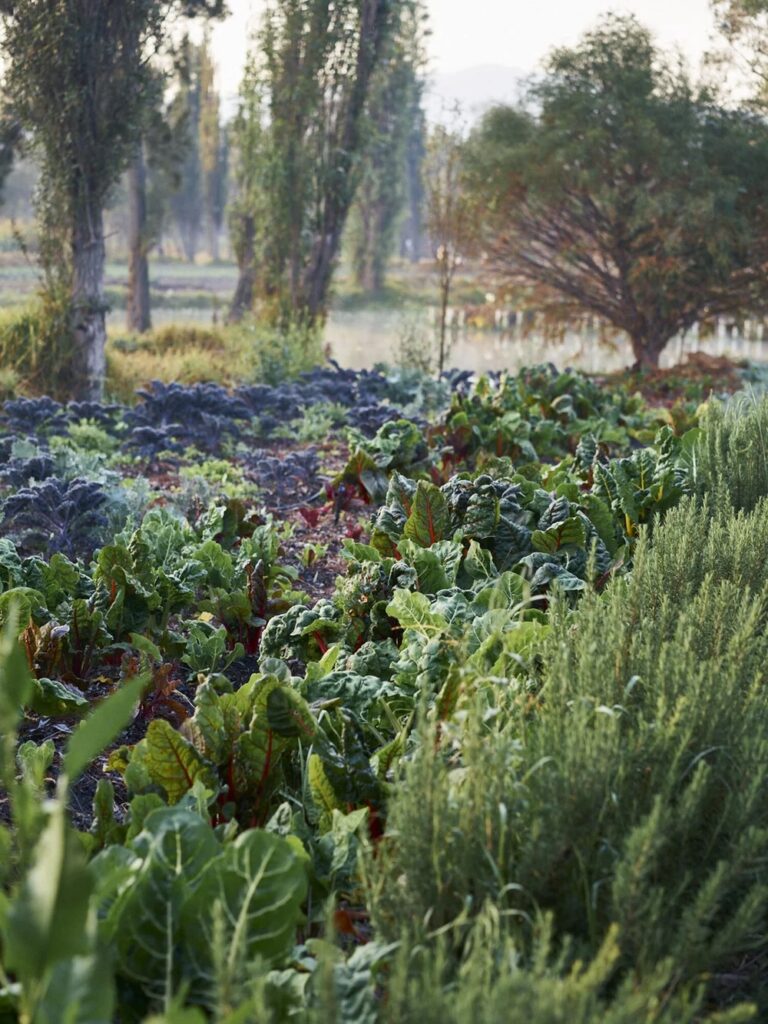
In southern Mexico City, the borough of Xochimilco has a network of canals flowing through the Chinampas, man-made agricultural islands that are the remnants of a vast water transport system built by the Mexica*. Most locals know it as a place where colourful gondola-like boats meander the narrow waterways, ferrying visitors on cruises while food vendors, artisans and mariachi bands float past. But in the midst of the party boat cruises, a collective called Arca Tierra is carving out calming spaces for regenerative agricultural practices and going back to using the Chinampas in the ways for which they were created in 900 AD. As a result, they not only provide fresh produce for 50 of the best restaurants in Mexico City, but also feed many local families directly, as well as educating farmers and visitors alike.
Orlando Lovell: We are here in the floating islands of the Chinampas. Can you tell me more about what they are and how they came to be?
Sebastián Herrera: The legend says that around 900 AD, Acatonallo, the leader of the Xochimilcas, came to the shores of a lake and discovered that they were incredibly fertile and ideal for agricultural production. But the open shore location provided ways for the people of the mountains to steal the produce of the land.
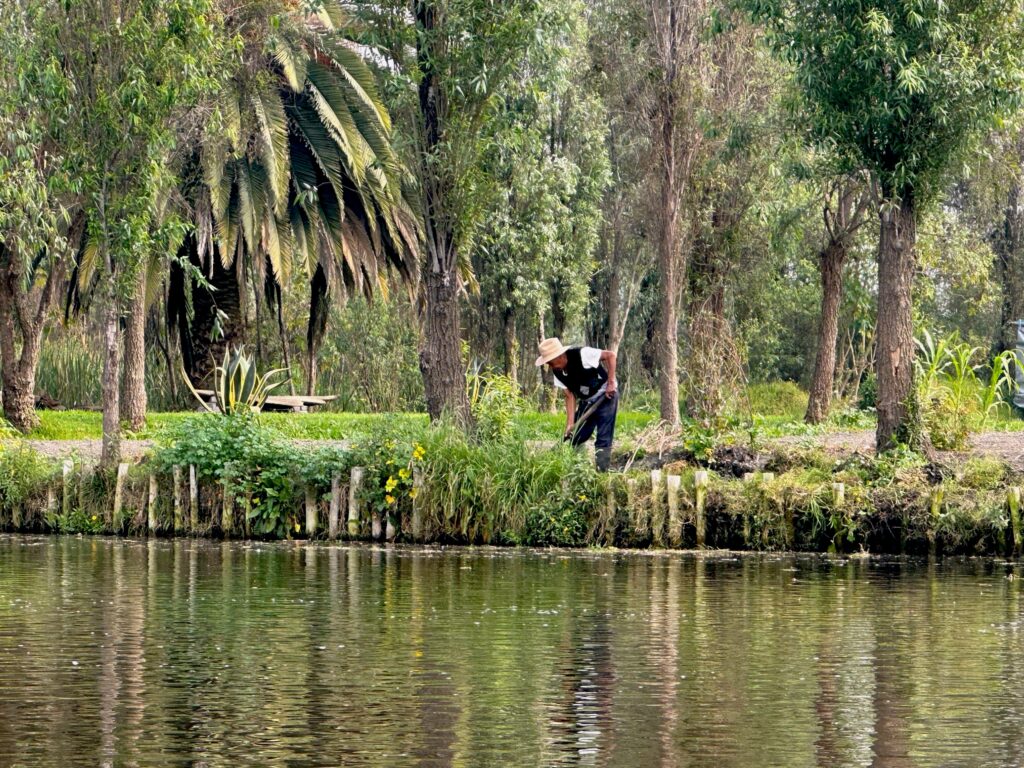
So he sent his people to search for a suitable place, and they found this island in the lake, a pool of mud, surrounded by carrizo canes – a refuge in the middle of the water that no one could reach. But when they tried to walk on this island, it started to disintegrate. So they gathered mud from the centre of the lake to make a sedimentary layer, they built a containment wall out of canes and reeds and added extra soil from the mountains. By adding organic materials to create a composting layer system and compacting the land to grow crops above the water level, they built what we now call the Chinampas.
Orlando Lovell: How are the Chinampas used today?
Sebastián Herrera: It’s not private property, but people think that it’s like proper property. We have a state-supported system for communal farming here called the ejido. An ejido is a way for us to give land to the people whose land was stolen. During Porfirio Diaz’s dictatorship [1876 – 1911], land was taken from the indigenous people, and they became indentured workers. So when the Mexican Revolution happened, there was a famous phrase that translates to “the people who work the land are the owners”. But because we lost the original farmers who owned the land, it was given to the workers after the revolution.
Because we lost the original farmers who owned the land, it was given to the workers after the revolution.
But then families fought among themselves, and the Chinampas began to divide or fall into disuse. The problem was, and still is, that the owners don’t communicate. Some sold their properties, thinking that it is private property, which is why more than 60 per cent of this area is abandoned, because people don’t care, or they don’t have the power to work the land as it should be. So here we have these 2215 hectares of land with very fertile soil that, sadly, is no longer used for agriculture.
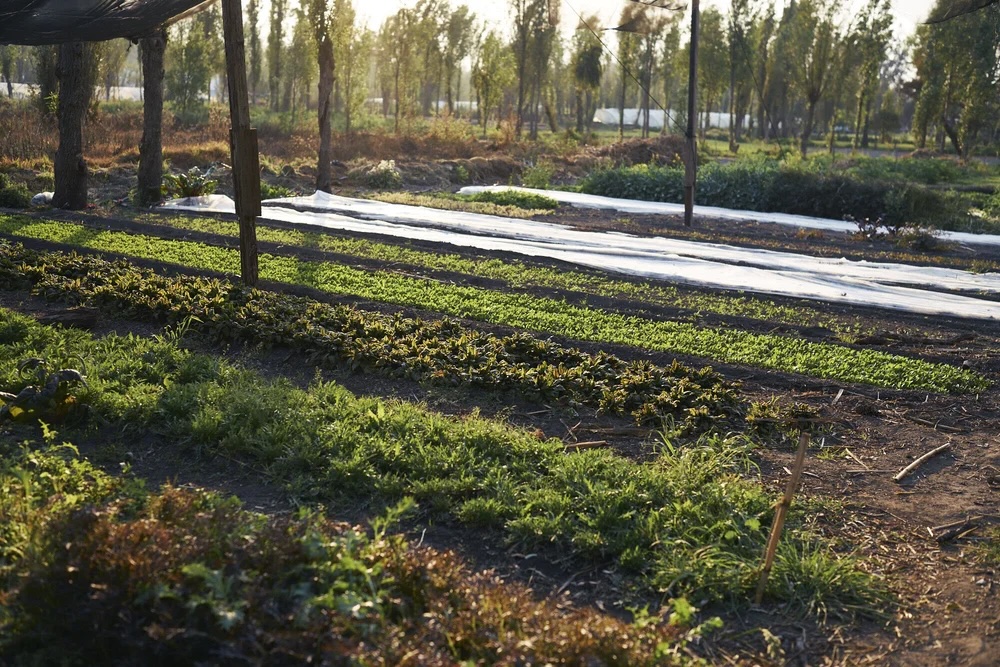
In 1987, this area became protected by UNESCO, which meant people were not allowed to come and build houses on it. Houses mean concrete, electricity, sewage systems and so on. Sewage is one of the biggest problems that we have. This whole area, the Valley of Mexico, used to be lakes, but now we’re surrounded by concrete. We killed the five lakes that we used to have, the five lakes that our ancestors used. The Spanish gave us the idea; they didn’t want to use the water, they just wanted to drink it, drink it, drink it. The Mexicans let the Eurocentric way win, and we started to forget our roots. We started to forget our past. We started to modify our ecosystems and hurt them.
We killed the five lakes that we used to have, the five lakes that our ancestors used.
We’re still slow to change. For example, even though we’re the country of corn, we are sons of corn, we do not produce enough to support ourselves, and the corn we import is different from our own native varieties. In our experience as farmers, people want things fast; they want them now, and they don’t like different shapes, colours, spots, or blemishes. And it’s a problem.
Orlando Lovell: Do you have a problem with invasive species here?
Sebastián Herrera: We have arrived at a point where, sadly, this is not a priority. We need to bring back native species, and that will always be our fight, but right now, we just need diversity because insects are missing, environments are being destroyed, and because the city is growing so fast.
Even though we’re the country of corn, we are sons of corn, we do not produce enough to support ourselves, and the corn we import is different from our own native varieties.
Orlando Lovell: You mentioned to me earlier that the future is ancestral. Which ancestors are you looking at? How far back do you look, and who are the ones you’re being guided by?
Sebastián Herrera: We are guided by all our ancestors, and that’s what we need people to understand. If we track all our civilisations, if we track all our farming systems in all the world, we can learn how easy it was for them to have food. The Chinampa system used to feed empires. The Xochimilcas established the Chinampas, but the ones that had the finest and best production in the history of the Chinampas were the Mexicas. The Mexicas, with the help of the Xochimilca tribe, were able to feed 3 – 400,000 people. But when the Spanish arrived, things started to change. But even they understood that they couldn’t destroy the Chinampas, because they needed them to provide food while they built their New Spain.
Orlando Lovell: Do you still work with the Xochimilcas?
Sebastián Herrera: Yes, and we’re very thankful to the people we work with who are from the original families of the Xochimilcas, because they teach us how the Chinampas function. Now we have also begun to expand our learning and gather information from all around the world, because we need to understand that all of our ancestors knew how their ecosystems worked. You can trace this through various cultures. For example, even though we are far, far away from the Peruvians, from the Mayas, from the Sioux, all these ancestral and indigenous tribes knew that if they took something from the environment, they needed to return it. As simple as that. Nowadays, we have forgotten that there was a balance. Balance is the most important thing that we need everywhere.
We have also begun to expand our learning and gather information from all around the world, because we need to understand that all of our ancestors knew how their ecosystems worked.
Orlando Lovell: Who are the other people you work with?
Sebastián Herrera: Javier over here, for example, learnt to be an electrical engineer, but he is also the fifth generation of the keepers of a blue corn seed native to Tlalpan. He knew that he would need it to keep the tradition alive, so he went back to the farms, and now he teaches the new generations of farmers, whilst he also helps his father and his mother with production. We are a network of experts doing what we can.
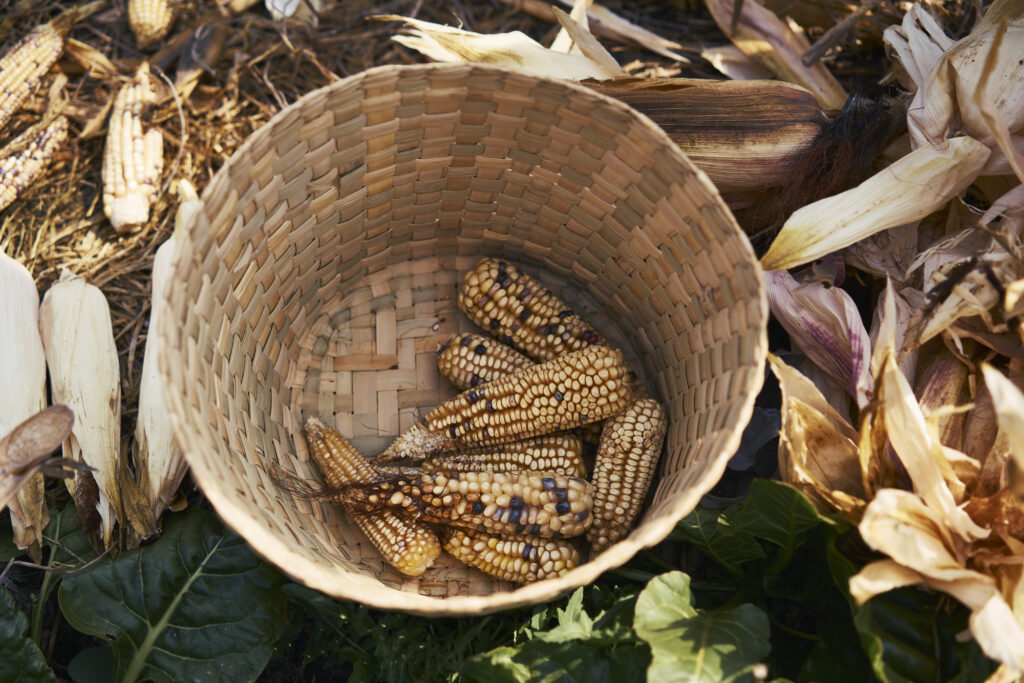
Orlando Lovell: Can you describe what a “keeper of seeds” does?
Sebastián Herrera: A keeper can be someone who guards the seed, someone who defends them, so we are also keepers of seeds. A percentage of all the seeds we use goes to production, and another percentage is for us to collect to reproduce genetic memories. That’s something industry never understands – for us to have a seed is to have a seed that learns from our errors, not from the errors of the plant. The plant doesn’t commit errors. We commit the errors. So, for example, last year was one of the rainiest seasons of our lives, but 2024 was one of the driest seasons that we have ever had. Our corn plants almost didn’t survive, but they managed it, and they learned from that. They learned that they needed to survive. Now they have genetic memory, something that humans will never fully understand. Plants are so intelligent, they know when to reproduce and when to die.
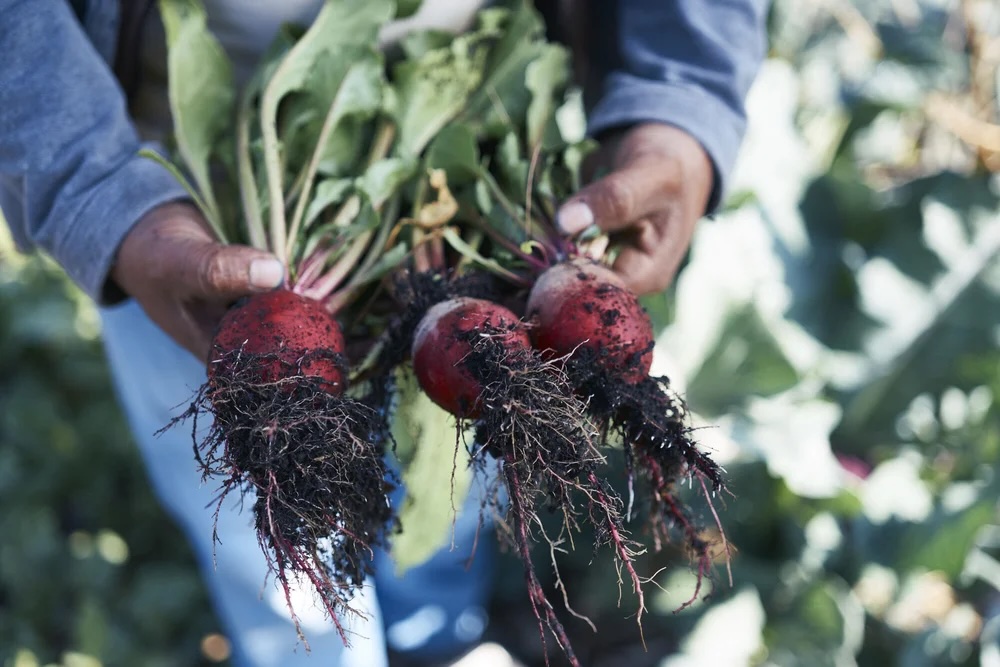
Orlando Lovell: So Arca Tierra’s role is to provide a kind of communication network to help people rediscover the practices of their ancestors?
Sebastián Herrera: The purpose of Arca, in terms of agriculture, is to show our producers how they can produce in the easiest ways for them to be viable, but also to save the ecosystems. Because, as Lucio Usobiaga, the co-founder of Arca Tierra, says, they are not farmers anymore; they are the guardians of the environment. They’re keepers of knowledge. What they need to do is not just produce crops, but produce life. When we produce vegetables for ourselves, we also produce vegetables for insects. The insects are going to pollinate, and thanks to that, we’re going to have diversity. The soil also has microorganisms that are equally alive, so we let the leftovers of production decompose in order to feed them and the soil, thereby keeping the environment balanced. And that’s what we need to show the farmers, be it in ancestral or modern ways of regenerative farming systems.
They are not farmers anymore; they are the guardians of the environment. They’re keepers of knowledge. What they need to do is not just produce crops, but produce life.
We have a network of 58 farmer families today, plus the Chinampas that we have recovered, plus the masters of Chinampas that work for us in an independent way. That’s how the Chinampas need to function. That’s how the Chinampas need to be empowered. We bring back the ancestral way of how to harvest, but we also want them to understand that it’s the simplest solution.
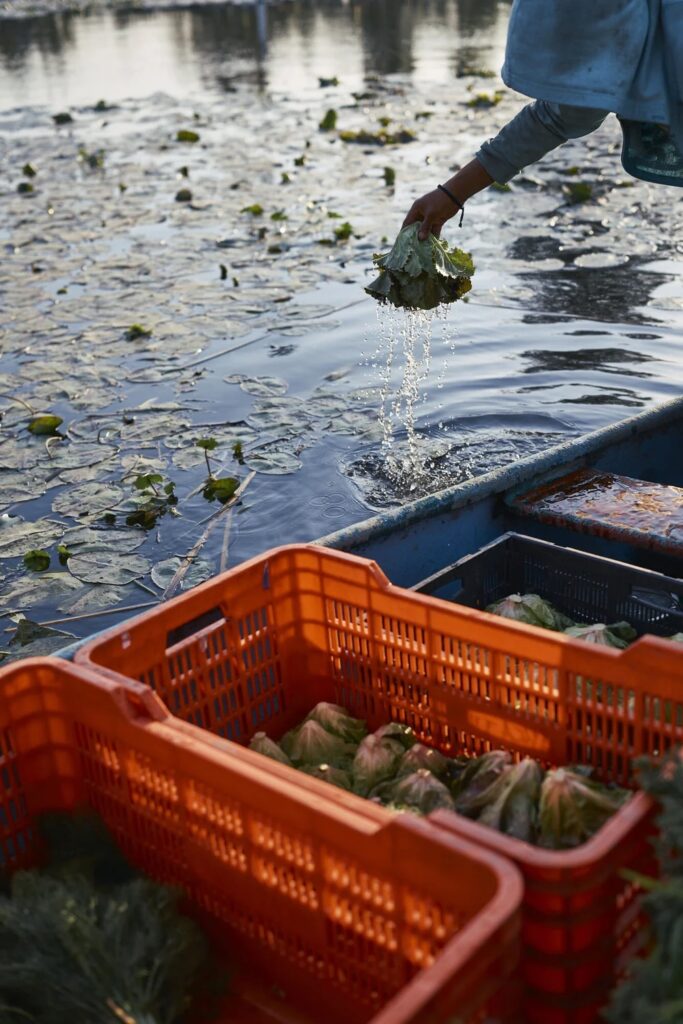
Regenerative farming systems from all over the world are also the foundation of our farming system here, because we have always needed to layer to keep the Chinampas above water – once a plant is fully grown, we cut off the excess, and we leave it on the land so it becomes compost and returns to the soil.
Orlando Lovell: How do you teach? How do you achieve this transfer of information? Do you all come together and talk, or do you go to the farmers and have specific exchanges with them about their land?
Sebastián Herrera: We do workshops, but we mainly let the families do their jobs, and just check in from time to time. Each Chinampa has one guardian to oversee production of the area. We introduce them to new systems of agriculture – we’re always trying to investigate new techniques, but tradition is always going to be there.
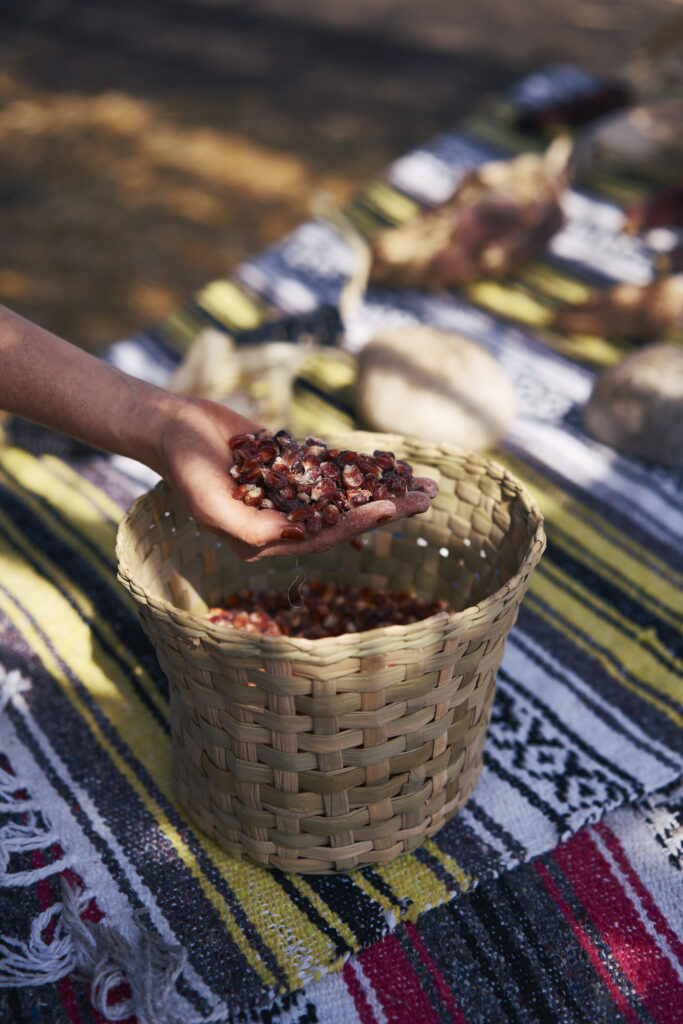
In addition, we have a new project called the School of Farmers, which is within the Iniciativa Agroecológica Xochimilco, and teaches young people about agriculture. Through this programme, we restore abandoned Chinampas to preserve the Chinampera culture, its planting traditions, festivities, biocultural heritage and traditional cuisine. We teach them all of the knowledge that we have, so that they can build new bridges through the generations.
We teach them all of the knowledge that we have, so that they can build new bridges through the generations.
Orlando Lovell: Is this all verbal transmission, or do you capture it somewhere?
Sebastián Herrera: It’s mainly verbal. We are starting to be interested in writing things down, but it’s still a problem. We’re speakers, we have the ancestral knowledge of many people who are maybe not with us anymore. So we are keepers of that knowledge, and we bring people here to understand. Just telling you that we sell to the best 50 restaurants in Mexico City and that, with our restaurant Baldio, we have the very first zero-waste restaurant in Mexico, is not the same as bringing you here to experience what we are doing.
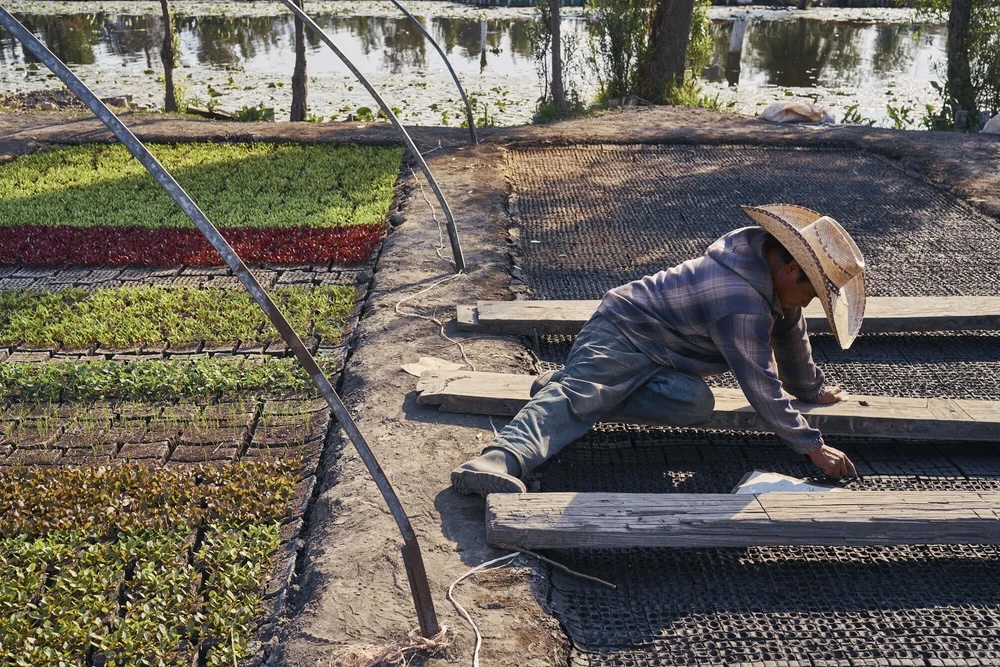
Orlando Lovell: Can you tell me more about how you and your team work the land?
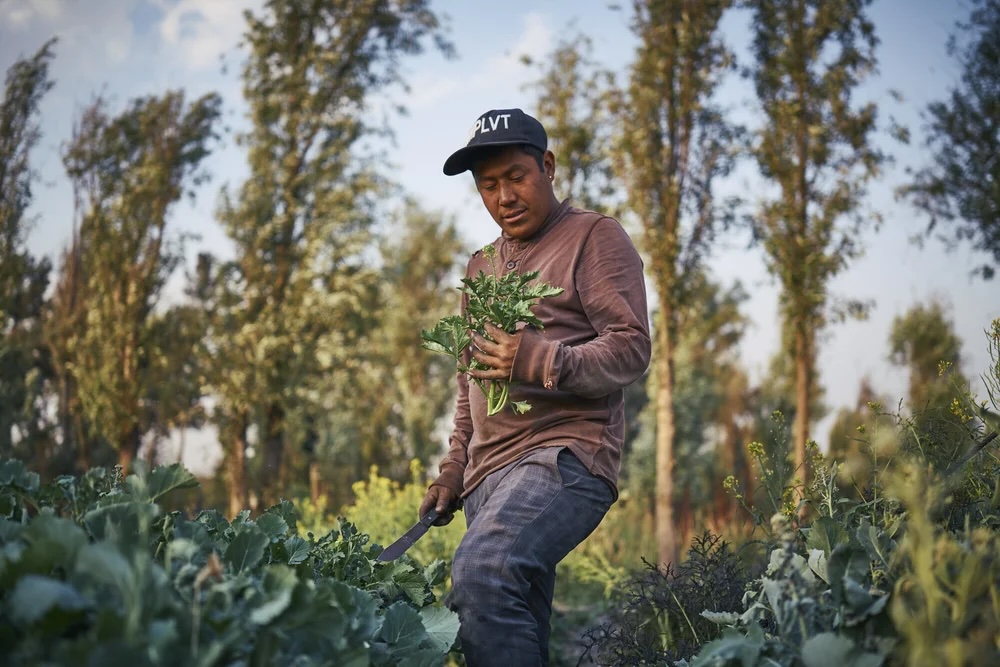
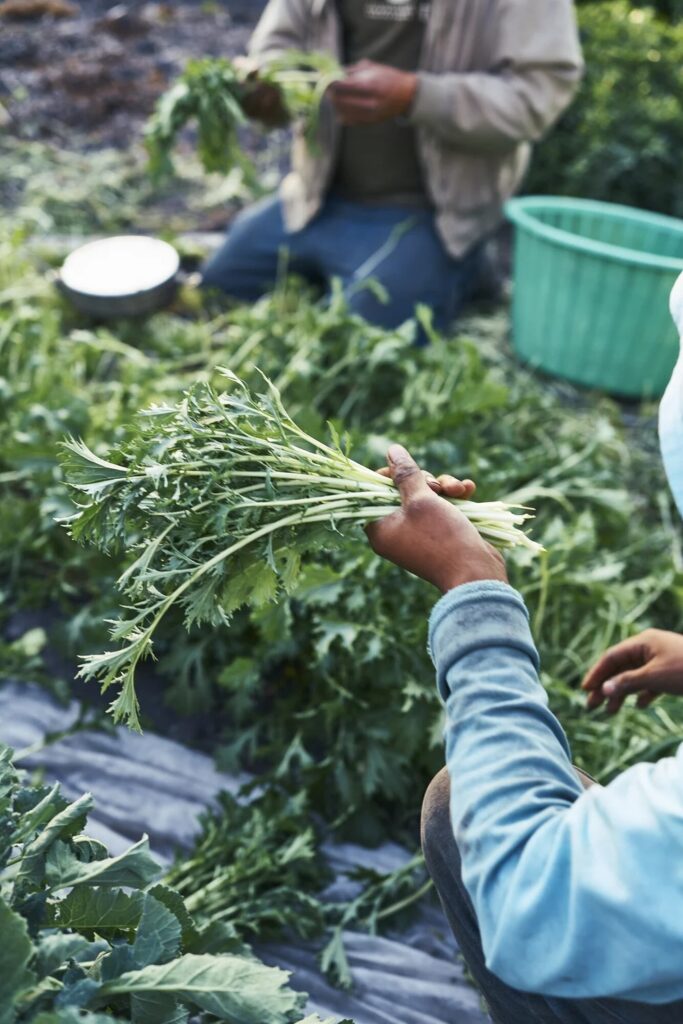
Sebastián Herrera: The method that created the Chinampas is the same method that shows us how ancestral technology is more efficient than any modern technology. We take mud from the centre of the canal, we mix it with water, clean it, we take everything out, all the grasses, all the leaves, all the trash, etc. We then put it in these indented planting bed areas on land, and then we let it dry for one or two days so that it changes from a liquid consistency to a thicker consistency. Then we cut this dryer mud into little blocks. One by one, the team of farmers make holes with their fingers in each of the blocks for a seed, and then covers it.
The method that created the Chinampas is the same method that shows us how ancestral technology is more efficient than any modern technology.
In one bed, we can have 17– 20,000 little plants, so the farmers need to make 17–20,000 holes in the soil with their fingers to place the seeds for the next generation of baby plants. With new methods of technology, we try to take humans out of the human equation, but it’s not the same. It’s so different – you need to feel it to understand it.
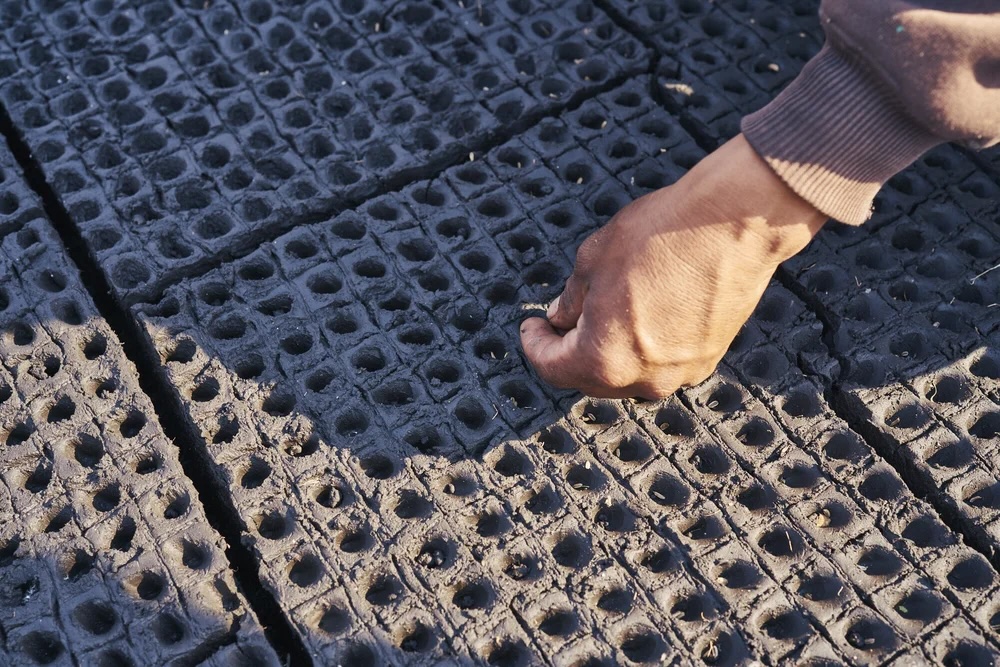
In the past, the people who worked in the Chinampas were not allowed to walk on them with shoes on, because you couldn’t connect; you were only grounded if you were barefoot. Everything is connected. So if we connect ourselves, whilst planting the baby plants, we also give them energy, we give them intention and that gets transferred further.
The soil here is very loose. Earthquakes here feel very aggressive, but it’s safer because there are no buildings, and we have trees that hold the land together. There’s something very unique about this soil; roots don’t go very deep because it’s so fertile that the plants get everything they need from the surface. It’s beautiful black earth. It’s our equivalent of terra preta, but it comes naturally through our farming practice.
Orlando Lovell: It sounds like yours is a rapidly growing system.
Sebastián Herrera: Yes, at the start of 2025, we only had 10 Chinampas, around 2 hectares. In one month, we could produce 2.5 tonnes of different vegetables. In 2026, we’re going to start with 15 Chinampas. So, we can double our production. In addition, we have seven masters of Chinampas who work independently. Each season, they grow more and are renting more Chinampas to do so.
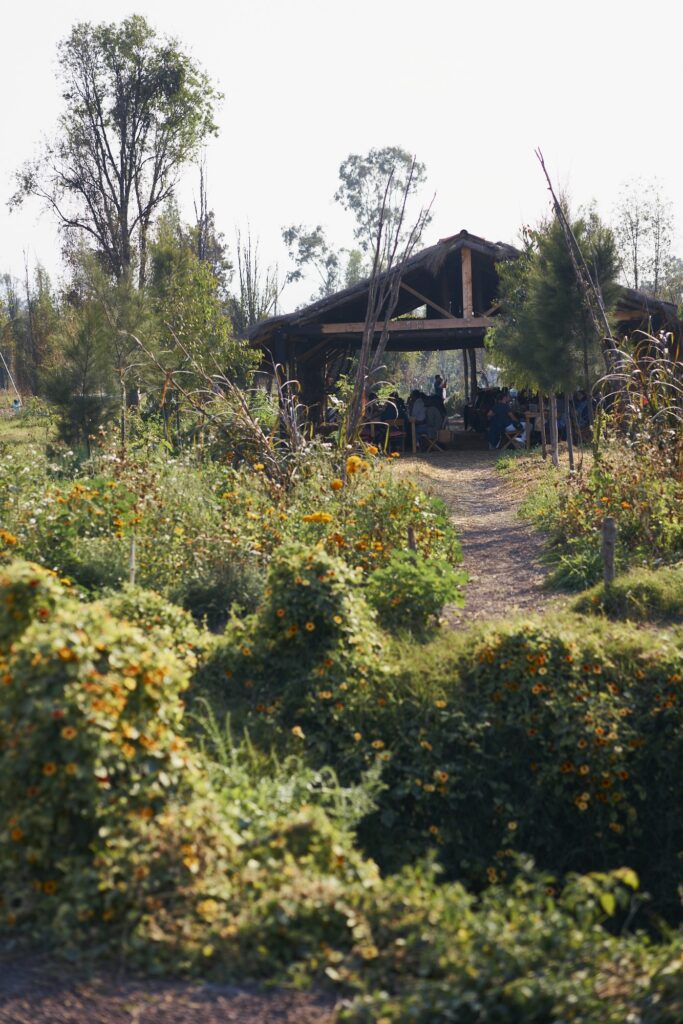
Our visitors are one of the greatest markets that we have, because they don’t just come to eat, they come to learn, and to pass on information.
We also have other allies in Milpa Alta, Hidalgo, Puebla, and elsewhere, who are using the same methods as we are. We buy their produce at a guaranteed price, collecting their produce and bringing it to the restaurants, families and visitors. Our visitors are one of the greatest markets that we have, because they don’t just come to eat, they come to learn, and to pass on information. This is the most important thing, because the ancient knowledge that we have is sadly only shared by voices now, and it is only going to be passed to those that we speak to. So that’s how we’re going to defend this. Maybe visitors are not going to remember all the information that we share, but there’s a tiny seed of something for the next time someone talks negatively about agriculture, they’re going to be ready to share what the real purpose of agriculture is.
*The term “Aztec” was popularised by German explorer Alexander von Humboldt in the early 19th century, deriving it from the Nahuatl word Aztlán, their mythical homeland, to describe the people who founded Tenochtitlán (the Mexica), though they called themselves Mexica.
Sebastián Herrera Figueroa is an agricultural engineer from the National Autonomous University of Mexico (UNAM) and Operations Manager at Arca Tierra. Raised in Mexico City, his path into agriculture began from an urban perspective and evolved into a deep commitment to regenerative practices, territory, and community-based food systems. His work focuses on building sustainable supply chains, strengthening relationships with farmers, and promoting agriculture that respects ecosystems, culture, and long-term resilience.
Arca Tierra is a Mexico-based project dedicated to regenerative agriculture and sustainable food systems. Working directly with small-scale farmers and rural communities, the project promotes agricultural practices that protect biodiversity, honour biocultural heritage, and strengthen local economies. By connecting rural and urban communities through fair trade, short supply chains, and education, Arca Tierra seeks to transform how food is produced and consumed – placing care for the land, people, and territory at the centre.
Title image: Pablo Antoní, courtesy Arca Tierra